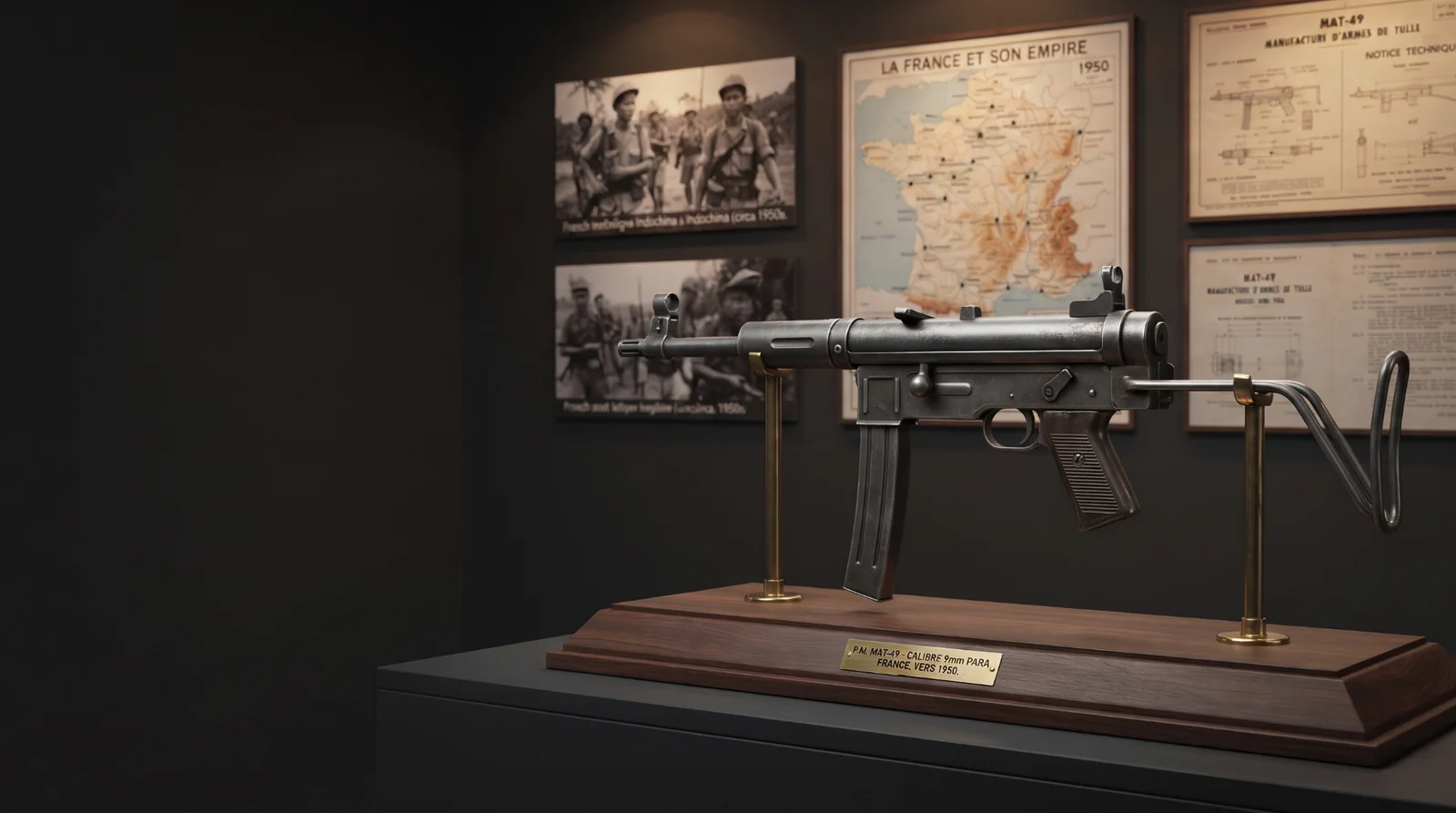
France’s postwar compact service submachine gun. This independent historical overview traces the origin, institutional journey, naming conventions and legacy of MAT-49 rather than promoting contemporary sales or providing operating instructions.
01 / ORIGIN: PEOPLE & FACTORIES
France’s post-World War II arsenal system sought a modern national submachine gun to replace a mixed inventory. The Manufacture d’armes de Tulle won the competition with the design that became the MAT-49.
02 / SERVICE, ADOPTION & THE HISTORICAL JOURNEY
The MAT-49 acquired a long postwar service history connected to French military and police institutions and the conflicts of the decolonization era. Its role changed as infantry weapon expectations evolved.
03 / NAMES, MARKS & FAMILY IDENTITY
MAT-49 refers to the standard family, while police and later variations warrant their own labels when the physical specimen differs.
Names encountered in catalogs, collections and searches include MAT49; MAT 49; French Tulle submachine gun. They are useful research leads, but a shared term does not verify a particular artifact's maker or production date. A responsible object record should cite a museum accession, factory mark or authoritative contemporary reference where possible.
04 / WHY IT MATTERS
Its place in history is tied to postwar reconstruction, French state industry and the transition away from wartime emergency weapons.
THE INDUSTRIAL CONTEXT
Submachine-gun histories are often driven by constraints: wartime urgency, smaller industrial plants, domestic security requirements, and export opportunities. A military model’s significance cannot be measured solely by its appearances in films or its position in a modern ranking.
Read the new source-led dossier →
THE RESEARCH DOSSIER
The MAT-49 tells the story of French postwar rearmament, national arsenals and the institutional afterlife of a compact service arm.
01 / French production after a disrupted war
France emerged from World War II with a patchwork of domestic and foreign small arms. The MAT-49 was selected in the late 1940s as the country rebuilt its military-industrial base and rationalized infantry weapons. Manufacture d’Armes de Tulle was central to the design’s identity; MAT is a factory designation rather than the surname of a designer. That factory connection separates the story from a general catalogue of submachine guns: a state armory, government trials and production priorities were all part of rebuilding national capacity. The model should be read against the earlier French MAS-38 and the postwar shift to 9 mm service equipment.
02 / An institution travels with its soldiers
Period accounts place the MAT-49 in French service in Indochina and later conflicts. The Dien Bien Phu memorial specifically identifies it as a familiar arm of French airborne troops during the battle, a contextual historical claim rather than proof of any individual gun’s field history. Some variants and production runs differed as French factories adjusted designs and manufacturing. The basic model name therefore should not be made to stand for one unchanging specimen. When comparing it with the Sterling or the Swedish K, the useful question is how national supply systems and mission requirements shaped distinct postwar outcomes, rather than which gun “won” an abstract contest.
03 / Factories, dates and what sources establish
Historical specialist accounts trace both Tulle manufacture and related production at Châtellerault. These narratives provide useful industrial chronology but may differ in how they count output or group variants. A careful biography should identify which numbers come from factory archives and which are repeated estimates. The French-language Dien Bien Phu memorial anchors a specific service association, while specialist histories place it inside state arsenal decision-making. Neither source identifies the illustration used on this page as an original museum object. Surviving stamps, dated manuals and holdings in French institutional collections are the logical next step for specimen-level certainty.
Still to verify. Check wartime unit attribution and factory-specific production totals against dated French armory records. Historical museum images on this page are AI illustrations, not authenticated photographs of a particular object.
KEY CHRONOLOGY
Principal milestone for the MAT-49: design, model date, adoption or early production (as explained in the text).
Core historical context for its design and institutional reputation.
Surviving photographs, national variants and museum accession records may document additional chapters.
Its history is studied through collections, manufacturer records and contemporary historical research.
THREE RESEARCH QUESTIONS
Where did MAT-49 originate?
Its principal origin is France, associated in this record with Manufacture d’armes de Tulle. Design origin, contract manufacture and later service-country inventories are not always the same thing.
What is the main historical milestone?
The chronology centers on 1949 and the Cold War setting. Sources sometimes use different dates for prototypes, adoption and production, and those events should not be presented as interchangeable.
Why does this design deserve its own biography?
Its place in history is tied to postwar reconstruction, French state industry and the transition away from wartime emergency weapons.
CONNECTED BIOGRAPHIES
Explore these related histories for context, without assuming the firearms share identical designs or service records:
- Owen Gun — a related historical record
- Sterling L2A3 — a related historical record
- Carl Gustaf m/45 — a related historical record
- Beretta M12 — a related historical record
SOURCES & RESEARCH NOTES
Research starting point: the reference below documents this model, its program, or the wider historical context. Where it covers an entire family, dates and claims about a particular variant should be checked against an object-level record. Do not mistake generated editorial artwork or textual summaries for archival primary evidence.
1 external reading source currently listed. This biography is a historical research overview; these links are research starting points and may cover a wider model family. They are not a claim that every detail has been independently verified. Our editorial method.
- forgottenweapons.com — historical reference ↗EXTERNAL
- AllGuns.co research method and source policy ↗METHOD
- Dien Bien Phu Memorial: MAT-49 ↗RESEARCHFrench memorial interpretation of wartime presence and national origin.
- Jean Huon: French MAT 49 history ↗RESEARCHSpecialist production chronology; figures need independent factory corroboration.
REVIEWED 2026-11-21 · INDEPENDENT HISTORY · NO GUN SALES OR MODIFICATION INSTRUCTIONS.