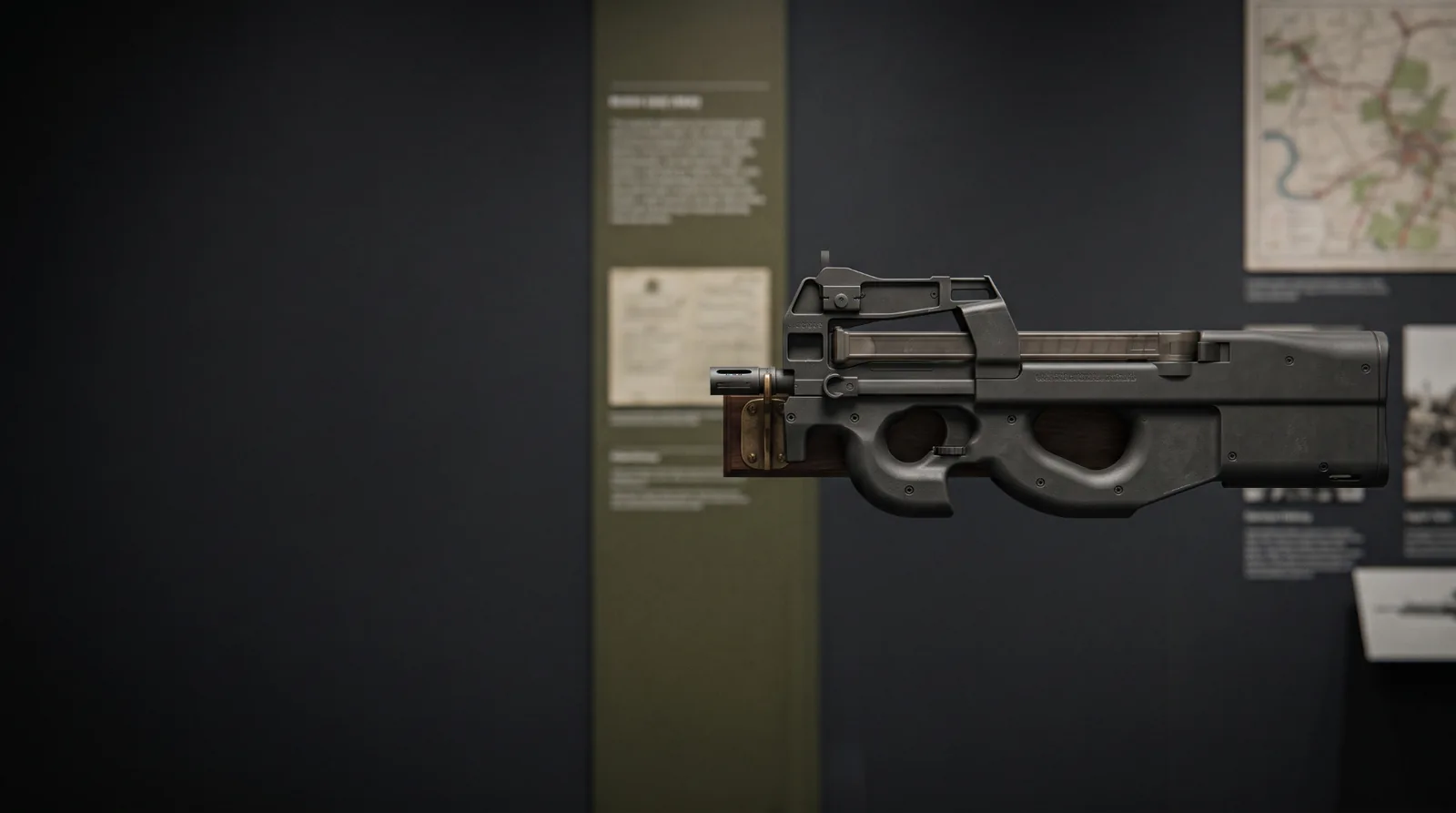
FN P90 is a submachine guns history rooted in Belgium. First associated with 1990, the design belongs to the wider story of unusual military designs. Its history is best understood through the people, institutions and events behind its name—not as a present-day product listing.
01 / THE ORIGIN
FN Herstal developed the P90 during a period when defense institutions were reconsidering compact arms for personnel with specialized duties. Its unconventional appearance made it one of the most visually recognizable late-Cold War designs.
02 / THE HISTORICAL JOURNEY
The program became part of a wider conversation about personal-defense weapons, NATO-era requirements, and industrial innovation in Belgium. Film and video-game imagery later amplified the silhouette far beyond its original institutional context.
03 / NAMES, VARIANTS & IDENTITY
P90 refers to a family with military and later related versions; official descriptions should be distinguished from fictional depictions.
Names also encountered in historical catalogs and searches include P90; FN Project 90; FN P90 PDW. These terms are useful starting points, not proof that two photographed objects share the same maker, date, or military provenance. When reading about a particular surviving specimen, look for a documented institutional collection number, manufacturer record, or contemporary source.
04 / WHY THIS MODEL MATTERS
Its legacy is the intersection of a specific design brief and a much larger cultural image. This history is more interesting than treating it as merely an unusual-looking submachine gun.
The broader context is the history of unusual military designs. Political institutions, supply contracts, and public memory often determine which firearms remain famous and which survive mainly through specialist archives. These distinctions matter more than modern rankings or unsupported claims of superiority.
Read the expanded historical research file →
THE HISTORICAL RESEARCH FILE
The P90 belongs to a late-Cold-War Belgian design program and a wider FN 5.7 project; its dates and military designation require context.
01 / A project with a defined historical context
FN Herstal describes development of its 5.7×28mm system beginning in the late 1980s and identifies the P90 as the personal-defense weapon developed alongside that program. The manufacturer also associates a later Five-seveN pistol with the broader family. These statements support a clear historical narrative: the P90 did not appear as an isolated consumer novelty or simply because its silhouette was unusual. It was part of a defense-industry response to changing ideas about personal equipment and institutional roles near the end of the Cold War. [1]
A manufacturer is a valuable primary source for corporate chronology, yet statements about real-world superiority or worldwide service need independent military and procurement confirmation. The encyclopedia should be careful not to transform promotional language into neutral historical fact.
02 / P90 and FN's wider product family
The name P90 is internationally recognizable, but later variant names and marketing descriptions belong to different historical moments. A current FN product catalogue is not direct proof of a 1990-era service configuration. Likewise, fictional depictions in games and films, though culturally influential, cannot establish an early factory design. Visitors searching 'Project 90,' 'FN P90' or the acronym PDW need a concise disambiguation and an explanation of what the dates in various sources actually refer to. [1]
Because some catalog records are updated or reorganized, AllGuns should preserve stable museum and institutional citations when available. A verified historical image of a dated specimen could improve this article more than another generic hero image.
03 / What makes the P90 a distinct encyclopedia entry
The Belgian program connects naturally to the FN FAL and Browning Hi-Power biographies through company history, not through a claim that the three designs are similar. The P90 also belongs in a Cold War-to-post-Cold-War exhibition of how different armed institutions defined equipment requirements. That educational connection adds value to the site’s cross-link network without becoming a buyer's guide. [1]
A stronger future article would include contemporary Belgian development announcements, dated defense trade coverage and independently verified contracts. Until that record is obtained, model chronology is preferable to unsupported statements about how many countries or organizations have fielded a given variant.
QUICK REFERENCE QUESTIONS
Where did the FN P90 originate?
Belgium, through FN Herstal’s late-1980s design program.
Was the P90 developed alone?
No. FN describes the P90 as part of a broader 5.7×28mm development effort.
THE NEXT ARCHIVAL QUESTION
Locate dated Belgian procurement or independent museum records to establish the first service configurations and their institutional distribution.
Editorial status: sourced historical research draft, not a completed archival verification of all marks, factory totals or service claims. Generated museum artwork is illustrative and not evidence of an authenticated surviving specimen.
THE HISTORICAL TIMELINE
Earliest major introduction or designation associated with this record
The defining historical setting for the model's service and reputation
Variants, national service histories, and museum documentation add important context
Preserved as part of military, sporting or industrial-design history
COMMON HISTORY QUESTIONS
What country did the FN P90 originate in?
The design's principal origin is Belgium. This is an origin label, not a claim that every later example was manufactured in the same country.
When was the FN P90 introduced?
1990 is the principal milestone used for this record. Prototype dates, military adoption, production, and later models may differ; always check which event a secondary source is dating.
What other names are associated with it?
Common search terms include P90; FN Project 90; FN P90 PDW. They may encompass nicknames, related service designations, or model-family references; consult primary documentation before equating specific variants.
EXPLORE CONNECTED HISTORIES
These neighboring biographies help place the model in a broader national or industrial context, without implying they are mechanically identical:
SOURCES & FURTHER READING
These links are editorial starting points. Where a linked source concerns a wider model family, a particular example or variant requires its own verification. This page is a historical overview, not an instruction manual.
2 external reading sources currently listed. This biography is a historical research overview; these links are research starting points and may cover a wider model family. They are not a claim that every detail has been independently verified. Our editorial method.
- Historical source: fnherstal.com ↗READING
- Additional institutional or historical reference ↗READING
- FN Herstal — 5.7 program and P90 development ↗DOCUMENTED SOURCEEvidence scope: Manufacturer history of P90 and related program; claims are manufacturer-attributed.
EDITORIAL EXPANSION: NOVEMBER 2026 · HISTORICAL STUDY · NO SALES, TRANSFERS OR MODIFICATION GUIDANCE.