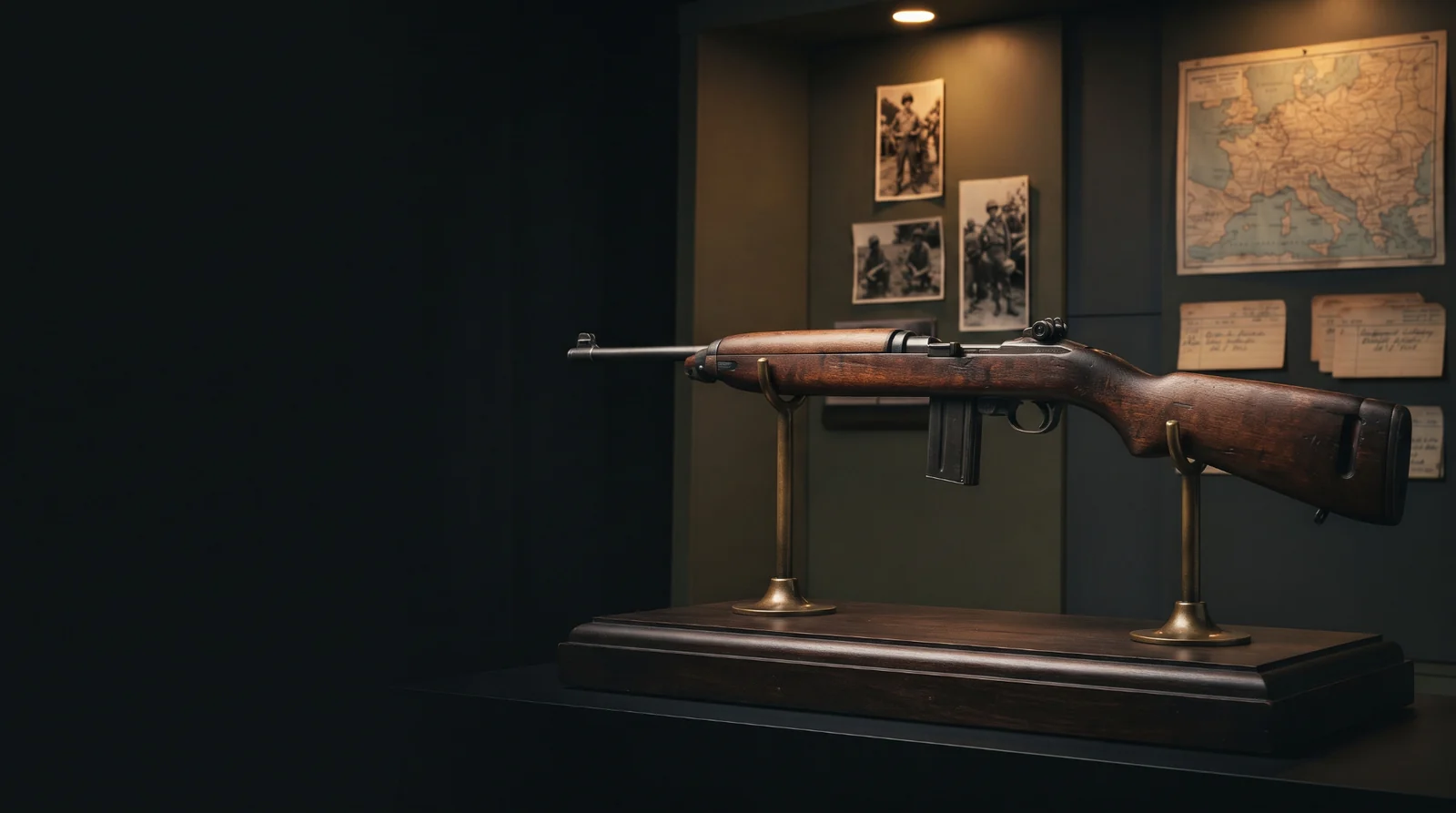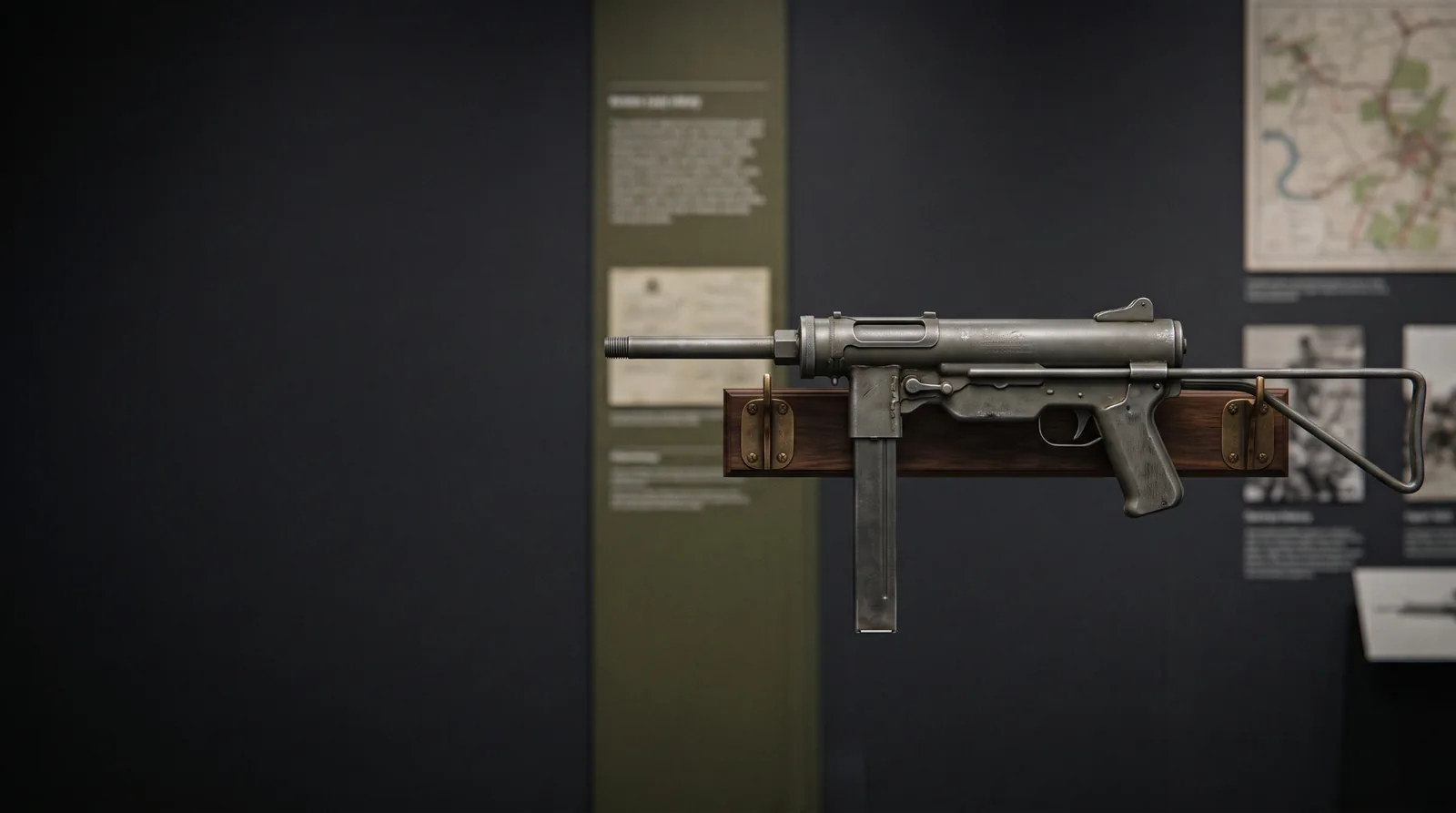
M3 'Grease Gun' is a submachine guns history rooted in United States. First associated with 1943, the design belongs to the wider story of world war ii submachine guns. Its history is best understood through the people, institutions and events behind its name—not as a present-day product listing.
01 / THE ORIGIN
The United States sought a less costly, simpler-to-produce submachine gun as wartime factory demands intensified. The resulting M3 became associated with General Motors’ Guide Lamp Division and a very different manufacturing philosophy from the Thompson.
02 / THE HISTORICAL JOURNEY
Its industrial nickname came from its practical appearance. The M3 and later M3A1 served beyond the Second World War and in multiple settings that make the gun more historically significant than the “budget replacement” label suggests.
03 / NAMES, VARIANTS & IDENTITY
The M3 and M3A1 were related but separate wartime and postwar variants; their historical labels should be precise.
Names also encountered in historical catalogs and searches include M3A1; M3 grease gun; United States M3. These terms are useful starting points, not proof that two photographed objects share the same maker, date, or military provenance. When reading about a particular surviving specimen, look for a documented institutional collection number, manufacturer record, or contemporary source.
04 / WHY THIS MODEL MATTERS
Few wartime firearms express production economics so clearly. The M3 biography belongs as much in an industrial-history museum as in a military collection.
The broader context is the history of world war ii submachine guns. Political institutions, supply contracts, and public memory often determine which firearms remain famous and which survive mainly through specialist archives. These distinctions matter more than modern rankings or unsupported claims of superiority.
Read the expanded historical research file →
THE HISTORICAL RESEARCH FILE
The M3 tells a different Second World War American industrial story from the Thompson: an economical standardized submachine gun associated with GM’s Guide Lamp.
01 / Why the U.S. built a different type of submachine gun
The M3 emerged in the United States during the Second World War as an alternative to more complex and costly submachine-gun production. The NRA National Firearms Museum identifies General Motors' Guide Lamp Division in its object account, anchoring the gun to a wartime industrial institution rather than only to its familiar nickname. The museum also describes the distinctive stamped-metal appearance that led U.S. soldiers to call it the “Grease Gun.” This is a rare case in which a nickname provides a clear historical search hook, but the official model designation should remain the reference entry's lead title. [1]
The M3's development belongs in a broader story about wartime scaling, factories that adapted to defense contracts and the administrative need for simplified manufacture. That industrial context is more useful historically than a superficial comparison of two guns' appearances.
02 / M3, M3A1 and the Thompson transition
The museum's account covers M3 and M3A1 production and describes the M3 family's relationship with the Thompson in the U.S. Army's late-war standardization. Yet a change of official standard should not be confused with immediate withdrawal of earlier equipment. The World War II timeline and later service continuation need separate entries. Searches for M3, M3A1 and the popular nickname often blend several phases of the story; AllGuns should clarify that the two official model designations are not identical. [2]
Production figures also depend on whether an account groups the M3 and M3A1. Where a museum summary offers an aggregate, the page should identify it as such rather than inventing a subtype breakdown. A specific surviving object establishes one specimen's identity, not the full factory total.
03 / Museum evidence and the image problem
This biography is especially vulnerable to AI-image errors. A generated picture that invents a forward grip or other conspicuous feature may look cinematic while misrepresenting the standard historic M3. AllGuns has correctly held a flawed illustration out of publication until it can be redrawn; accuracy matters more than filling every empty slot. A museum photo with accession, known manufacturer and date would be better archival evidence. [1]
The wider article can connect the M3 to the Thompson and Sten as three very different national production stories within the Second World War. The comparison should emphasize industrial and institutional context, not instruction on use or fabrication.
QUICK REFERENCE QUESTIONS
Where did the M3 nickname “Grease Gun” come from?
It refers to the M3’s unusual stamped-metal appearance, as described by the NRA National Firearms Museum.
Is M3A1 the same formal model as the M3?
No. The M3A1 is a separately designated subsequent version in the same historical family.
THE NEXT ARCHIVAL QUESTION
Use GM wartime contracts and accessioned examples to separate M3 and M3A1 production histories precisely.
Editorial status: sourced historical research draft, not a completed archival verification of all marks, factory totals or service claims. Generated museum artwork is illustrative and not evidence of an authenticated surviving specimen.
THE HISTORICAL TIMELINE
Earliest major introduction or designation associated with this record
The defining historical setting for the model's service and reputation
Variants, national service histories, and museum documentation add important context
Preserved as part of military, sporting or industrial-design history
COMMON HISTORY QUESTIONS
What country did the M3 'Grease Gun' originate in?
The design's principal origin is United States. This is an origin label, not a claim that every later example was manufactured in the same country.
When was the M3 'Grease Gun' introduced?
1943 is the principal milestone used for this record. Prototype dates, military adoption, production, and later models may differ; always check which event a secondary source is dating.
What other names are associated with it?
Common search terms include M3A1; M3 grease gun; United States M3. They may encompass nicknames, related service designations, or model-family references; consult primary documentation before equating specific variants.
EXPLORE CONNECTED HISTORIES
These neighboring biographies help place the model in a broader national or industrial context, without implying they are mechanically identical:
- SKS-45 — Soviet Union
- U.S. M1 Carbine — United States
- Sa vz. 58 — Czechoslovakia
SOURCES & FURTHER READING
These links are editorial starting points. Where a linked source concerns a wider model family, a particular example or variant requires its own verification. This page is a historical overview, not an instruction manual.
2 external reading sources currently listed. This biography is a historical research overview; these links are research starting points and may cover a wider model family. They are not a claim that every detail has been independently verified. Our editorial method.
- Historical source: www.americanrifleman.org ↗READING
- Additional institutional or historical reference ↗READING
- NRA National Firearms Museum — General Motors M3 ↗DOCUMENTED SOURCEEvidence scope: Museum description of GM Guide Lamp, nickname and M3/M3A1 chronology.
- U.S. Army historical survey — M3 ↗DOCUMENTED SOURCEEvidence scope: Army museum survey covering wartime issue chronology.
EDITORIAL EXPANSION: NOVEMBER 2026 · HISTORICAL STUDY · NO SALES, TRANSFERS OR MODIFICATION GUIDANCE.