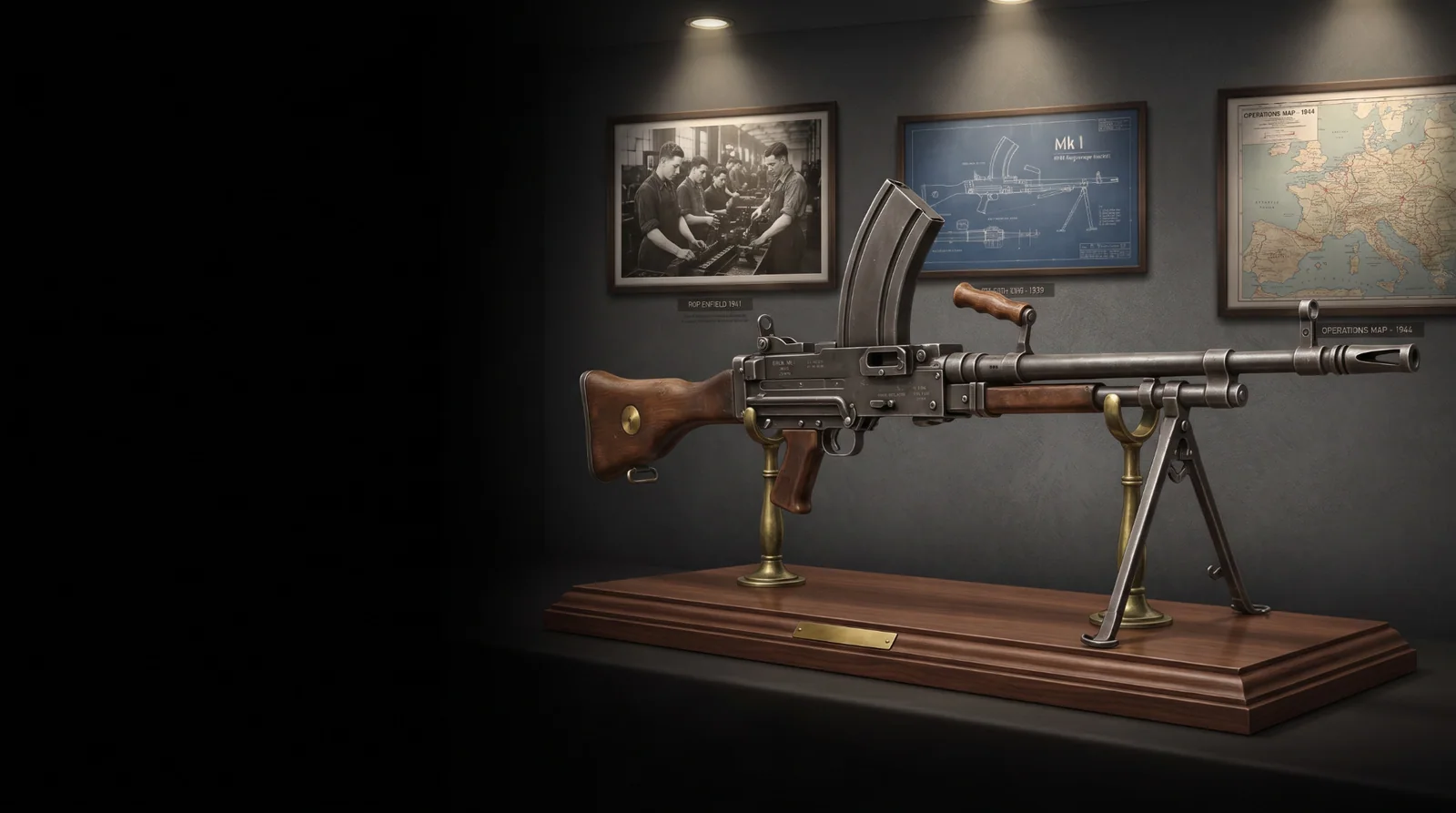
A Czech design lineage becomes a defining British infantry arm. This independent historical overview traces the origin, institutional journey, naming conventions and legacy of Bren Light Machine Gun rather than promoting contemporary sales or providing operating instructions.
01 / ORIGIN: PEOPLE & FACTORIES
The Bren traces its industrial roots to Czech arms design and British selection and adaptation. Its name famously joins Brno and Enfield, highlighting a cross-national development history often lost behind the British wartime silhouette.
02 / SERVICE, ADOPTION & THE HISTORICAL JOURNEY
First issued in the late 1930s, it became a familiar British and Commonwealth weapon during World War II and afterward. The many marks, manufacturers and postwar adaptations should be kept distinct in any detailed collection catalog.
03 / NAMES, MARKS & FAMILY IDENTITY
Bren Mk I, Mk II, Mk III and later L4 references relate to successive developments, not identical objects.
Names encountered in catalogs, collections and searches include BREN gun; Bren Mk I; British Bren light machine gun. They are useful research leads, but a shared term does not verify a particular artifact's maker or production date. A responsible object record should cite a museum accession, factory mark or authoritative contemporary reference where possible.
04 / WHY IT MATTERS
The Bren illustrates how an imported design idea could become central to a country’s military identity through local manufacture and long institutional service.
WHY PORTABLE AUTOMATIC SUPPORT MATTERED
As modern armies reorganized infantry units, they sought automatic weapons that could move with the section rather than remain fixed in static positions. The resulting systems were shaped by industrial capacity and doctrine, and different countries reached different solutions before, during and after the two world wars.
Read the new source-led dossier →
THE RESEARCH DOSSIER
The Bren is a case study in British international procurement: a Czech design lineage adapted and manufactured through the Enfield industrial system.
01 / From Brno to Enfield
The name Bren itself preserves the link between the Czech city of Brno and Britain’s Royal Small Arms Factory at Enfield. The National Army Museum’s collection records explain this background and identify manufacture of the British version before the Second World War. The history therefore begins with evaluation, acquisition and adaptation—not with a standalone wartime invention. This is a valuable counterexample to the idea that countries always developed service weapons from scratch. Our biography should distinguish the Czech antecedents from the finished British models and avoid treating a shared outline as proof that all earlier prototypes were identical to wartime Brens.
02 / A family across several service periods
The National Army Museum catalogues a .303 Mk I specimen and a wartime Mk II, as well as later examples in a different ammunition era. Those accessioned objects support a chronology of related variants, but they should not be collapsed into a generic “Bren Mk I.” Changes in model, manufacturing environment and later conversion have historical importance independent of claims about battlefield performance. The archive should therefore present the Mk I, Mk II and subsequent L4 lineage as linked but distinct records. In object descriptions, serial markings and documented collection history matter more than how closely a generated museum illustration resembles a particular period photograph.
03 / Comparative industrial history
The Bren’s service story is linked to the Lewis gun before it and to changing British and Commonwealth logistics afterward. A reader should be able to move between those biographies and understand the institutional transition. National Army Museum records are strong evidence for individual artifact classification and maker background; they do not alone establish every annual output figure or deployment pattern. Production totals and country-specific service dates should be checked against Enfield factory and War Office records. The resulting entry is about adaptation, procurement and endurance, not a list of uncontextualized specifications. That is the kind of nuance a well-sourced reference archive can offer.
Still to verify. Check specific Enfield production ledgers and dated British variant descriptions before adding factory-level counts. Historical museum images on this page are AI illustrations, not authenticated photographs of a particular object.
KEY CHRONOLOGY
Principal milestone for the Bren Light Machine Gun: design, model date, adoption or early production (as explained in the text).
Core historical context for its design and institutional reputation.
Surviving photographs, national variants and museum accession records may document additional chapters.
Its history is studied through collections, manufacturer records and contemporary historical research.
THREE RESEARCH QUESTIONS
Where did Bren Light Machine Gun originate?
Its principal origin is United Kingdom / Czechoslovakia, associated in this record with Royal Small Arms Factory Enfield and allied manufacturers. Design origin, contract manufacture and later service-country inventories are not always the same thing.
What is the main historical milestone?
The chronology centers on 1937 and the World War II setting. Sources sometimes use different dates for prototypes, adoption and production, and those events should not be presented as interchangeable.
Why does this design deserve its own biography?
The Bren illustrates how an imported design idea could become central to a country’s military identity through local manufacture and long institutional service.
CONNECTED BIOGRAPHIES
Explore these related histories for context, without assuming the firearms share identical designs or service records:
- Lewis Gun — a related historical record
- Degtyaryov DP-27 — a related historical record
- Stoner 63 — a related historical record
- RSC M1917 — a related historical record
SOURCES & RESEARCH NOTES
Research starting point: the reference below documents this model, its program, or the wider historical context. Where it covers an entire family, dates and claims about a particular variant should be checked against an object-level record. Do not mistake generated editorial artwork or textual summaries for archival primary evidence.
1 external reading source currently listed. This biography is a historical research overview; these links are research starting points and may cover a wider model family. They are not a claim that every detail has been independently verified. Our editorial method.
- collection.nam.ac.uk — historical reference ↗EXTERNAL
- AllGuns.co research method and source policy ↗METHOD
- National Army Museum — Bren Mk I specimen ↗RESEARCHObject and institutional development chronology.
- National Army Museum — Bren Mk II, 1942 ↗RESEARCHDated wartime variant record.
- National Army Museum — L4A1 Bren ↗RESEARCHLater variant and service transition evidence.
REVIEWED 2026-11-21 · INDEPENDENT HISTORY · NO GUN SALES OR MODIFICATION INSTRUCTIONS.