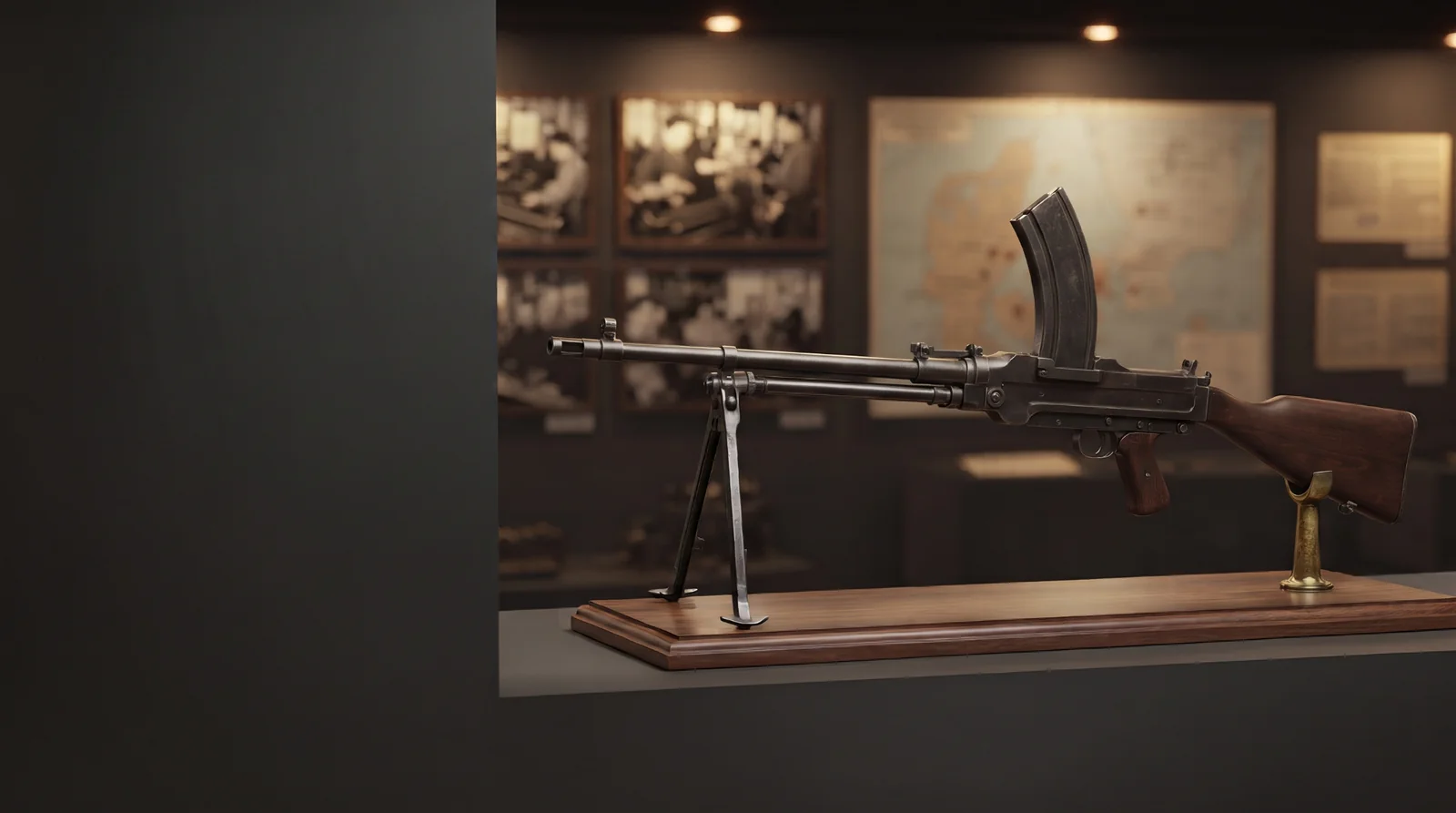
An early Danish design that helped define the light machine gun. This independent historical overview traces the origin, institutional journey, naming conventions and legacy of Madsen Light Machine Gun rather than promoting contemporary sales or providing operating instructions.
01 / ORIGIN: PEOPLE & FACTORIES
The Madsen is among the earliest successful portable machine-gun designs, with its commercial and military history beginning around 1902. Denmark’s international position in arms manufacturing gave the gun an export reach far beyond its place of origin.
02 / SERVICE, ADOPTION & THE HISTORICAL JOURNEY
Its extraordinarily long manufacture and overseas service make it difficult to reduce to a single nation or date. Madsens in museum collections can represent different decades and contractual variants even when they share a recognizable silhouette.
03 / NAMES, MARKS & FAMILY IDENTITY
Madsen M1902/04 and later Madsen machine-gun patterns share a family history, not a uniform production record.
Names encountered in catalogs, collections and searches include Madsen LMG; Madsen 1902; Madsen M1902/04. They are useful research leads, but a shared term does not verify a particular artifact's maker or production date. A responsible object record should cite a museum accession, factory mark or authoritative contemporary reference where possible.
04 / WHY IT MATTERS
This firearm provides a strong opening chapter for the machine-gun category: its chronology predates many more famous First World War designs.
WHY PORTABLE AUTOMATIC SUPPORT MATTERED
As modern armies reorganized infantry units, they sought automatic weapons that could move with the section rather than remain fixed in static positions. The resulting systems were shaped by industrial capacity and doctrine, and different countries reached different solutions before, during and after the two world wars.
Read the new source-led dossier →
THE RESEARCH DOSSIER
One of the longest-lived early portable machine-gun families, the Danish Madsen is best understood as an export and military-industrial history.
01 / A Danish origin with an international footprint
The Madsen story begins in Denmark around the turn of the twentieth century. The Aalborg Defence and Garrison Museum documents the Danish Riffelsyndikat/DISA industrial lineage and dates an early model to 1902. Its account also describes a remarkably international commercial history, with sales to multiple countries over subsequent decades. Such manufacturer and museum chronology is a stronger foundation than statements that the model was “the first” in an undifferentiated category. The Madsen belongs to a period when armies were experimenting with lighter automatic support, but national procurement and naming differed. The catalog needs to distinguish the original Danish family from later regional configurations and service designations.
02 / The export life complicates simple dates
Unlike weapons that appear briefly in one national program, the Madsen circulated through generations of contracts and foreign users. A 1902 introduction date is not the date of every Madsen specimen, and a museum photograph from one country cannot stand for all exports. Specialist studies describe long production and service lives; each numerical claim should be tied to a period and an identifiable producer. The model illustrates why an encyclopedia should not offer a single end-of-service date when different forces made independent decisions. Collections, shipping records and military manuals may support a chronology, but their dates reflect different events: design, sale, acceptance, refurbishment or disposal.
03 / What industrial records should add
The Danish museum’s overview is a useful national starting point, and specialist histories give context for why Madsen designs remained recognizable in several continents. They do not automatically determine the original identity of a particular photographed gun. An archive-quality entry should eventually include verified Danish factory naming, individual export contracts and documented changes in corporate identity. Readers comparing the Madsen to the Lewis and later Bren should see three contrasting routes to automatic infantry support: early Danish export manufacture, Anglo-American development and British adoption of a Czech-derived model. The existing museum-style rendering is not evidence of a specific Madsen variant.
Still to verify. Resolve country-by-country model names and serial-number provenance from Danish production and export records. Historical museum images on this page are AI illustrations, not authenticated photographs of a particular object.
KEY CHRONOLOGY
Principal milestone for the Madsen Light Machine Gun: design, model date, adoption or early production (as explained in the text).
Core historical context for its design and institutional reputation.
Surviving photographs, national variants and museum accession records may document additional chapters.
Its history is studied through collections, manufacturer records and contemporary historical research.
THREE RESEARCH QUESTIONS
Where did Madsen Light Machine Gun originate?
Its principal origin is Denmark, associated in this record with Danish Madsen industrial enterprises. Design origin, contract manufacture and later service-country inventories are not always the same thing.
What is the main historical milestone?
The chronology centers on 1902 and the Early 20th century setting. Sources sometimes use different dates for prototypes, adoption and production, and those events should not be presented as interchangeable.
Why does this design deserve its own biography?
This firearm provides a strong opening chapter for the machine-gun category: its chronology predates many more famous First World War designs.
CONNECTED BIOGRAPHIES
Explore these related histories for context, without assuming the firearms share identical designs or service records:
- Bren Light Machine Gun — a related historical record
- Lewis Gun — a related historical record
- Stoner 63 — a related historical record
- RSC M1917 — a related historical record
SOURCES & RESEARCH NOTES
Research starting point: the reference below documents this model, its program, or the wider historical context. Where it covers an entire family, dates and claims about a particular variant should be checked against an object-level record. Do not mistake generated editorial artwork or textual summaries for archival primary evidence.
1 external reading source currently listed. This biography is a historical research overview; these links are research starting points and may cover a wider model family. They are not a claim that every detail has been independently verified. Our editorial method.
- collection.awm.gov.au — historical reference ↗EXTERNAL
- AllGuns.co research method and source policy ↗METHOD
- Aalborg Defence Museum — Danish small arms ↗RESEARCHDanish museum on Riffelsyndikat/DISA and international exports.
- Small Arms Review archive — Madsen history ↗RESEARCHSpecialist production and export narrative, secondary source.
REVIEWED 2026-11-21 · INDEPENDENT HISTORY · NO GUN SALES OR MODIFICATION INSTRUCTIONS.