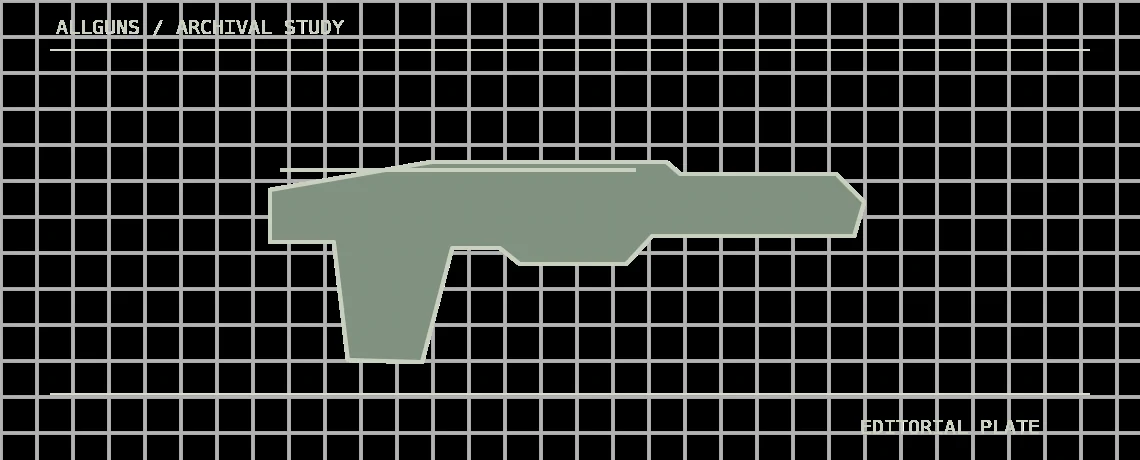
Some designs outlive the institution that first adopted them. The M1911 went from a U.S. Army sidearm to a century-spanning reference point for American handgun culture.
01 / THE ORIGIN
John Moses Browning’s self-loading pistol work developed across several years of military testing and changing requirements. The U.S. Army adopted the .45-caliber Model 1911, and Colt became closely identified with the new sidearm. Its formal designation gives the model an unusually clear date in the history of American small arms.
02 / THE JOURNEY
The pistol appeared in both world wars and remained a standard U.S. military sidearm for decades, with numerous production runs and wartime contractors. The M1911A1 revision became particularly recognizable. Across its service life, the design accumulated stories of soldiers, armorers, collectors, and manufacturers—sometimes far removed from the original procurement competitions.
03 / THE LEGACY
The Beretta M9’s adoption during the 1980s ended the M1911’s role as the primary U.S. sidearm, but not its influence. Sporting, commemorative, and custom examples made the M1911 a durable cultural object. It shows how a military specification can become a design language that continues to be reinterpreted long after its first adoption.
THE HISTORICAL TIMELINE
U.S. Army adoption
M1911A1 refinements enter the story
Wartime production broadens
Primary U.S. sidearm role transitions
SOURCES & READING
These are starting points for independent research. Where sources cover a broader family, model-specific details should be checked against period records.
- Smithsonian: Colt U.S. Model 1911 ↗REFERENCE
LAST EDITORIAL REVIEW: NOVEMBER 2026 · HISTORICAL SUMMARY · NO BUY/SELL CONTENT.