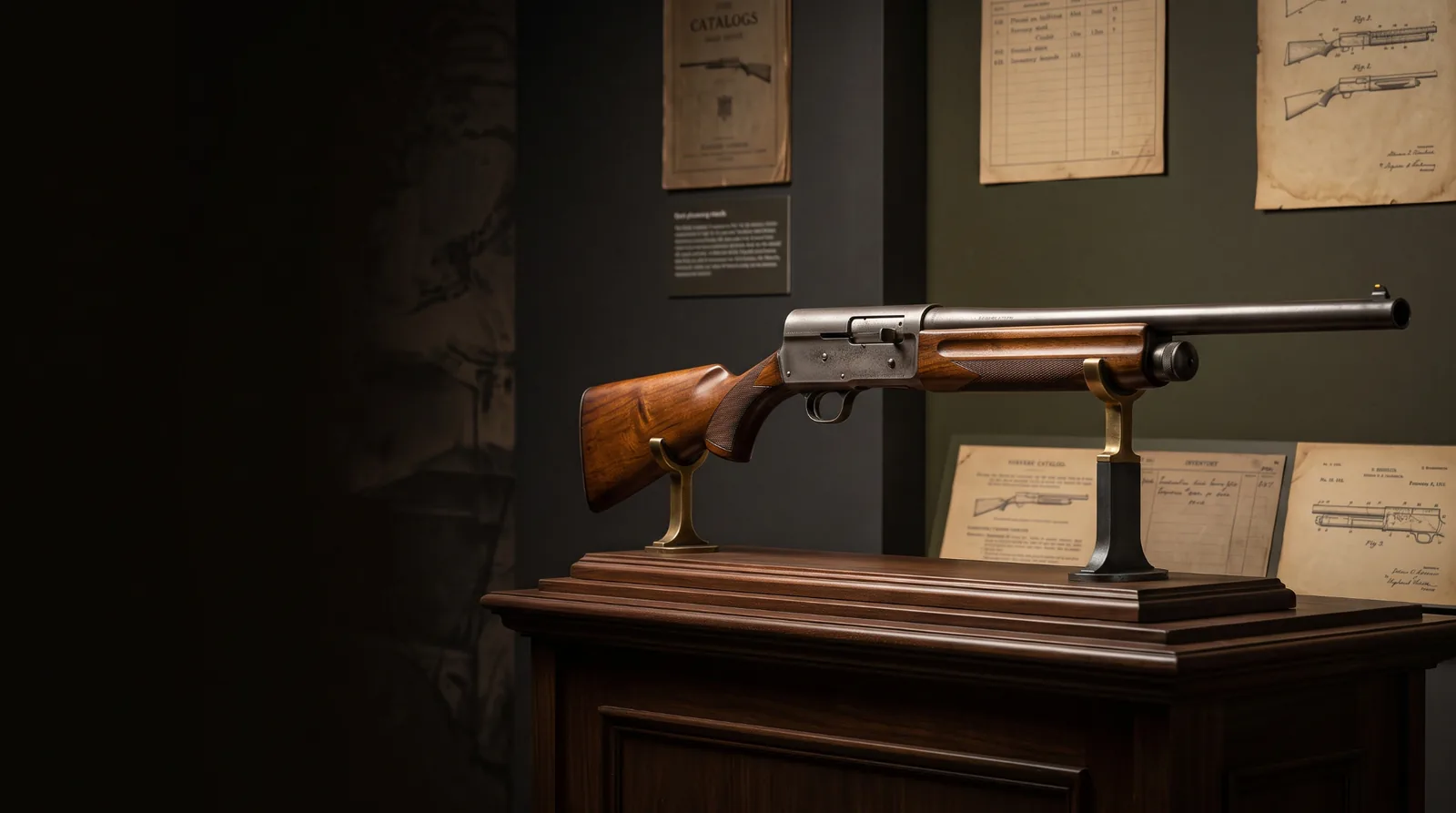
Browning Auto-5 is a shotguns history rooted in Belgium / United States. First associated with 1903, the design belongs to the wider story of early self-loading designs. Its history is best understood through the people, institutions and events behind its name—not as a present-day product listing.
01 / THE ORIGIN
John Moses Browning developed the Auto-5 concept at the turn of the twentieth century and its commercial history began through European and American manufacturing relationships. It became one of the defining forms of the self-loading shotgun.
02 / THE HISTORICAL JOURNEY
Its instantly recognizable profile later appeared in the sporting cultures of multiple countries. The different brands, manufacturing periods, and national histories make the Auto-5 more than a single American factory story.
03 / NAMES, VARIANTS & IDENTITY
Auto-5, Automatic Five, and A-5 can refer to historically connected naming traditions; the modern brand name alone does not date a specimen.
Names also encountered in historical catalogs and searches include Browning A5; Auto 5; Automatic 5 shotgun. These terms are useful starting points, not proof that two photographed objects share the same maker, date, or military provenance. When reading about a particular surviving specimen, look for a documented institutional collection number, manufacturer record, or contemporary source.
04 / WHY THIS MODEL MATTERS
The design’s exceptional longevity makes it a natural entry point to the history of sporting technology and the relationship between inventors and manufacturers.
The broader context is the history of early self-loading designs. Political institutions, supply contracts, and public memory often determine which firearms remain famous and which survive mainly through specialist archives. These distinctions matter more than modern rankings or unsupported claims of superiority.
Read the expanded historical research file →
THE HISTORICAL RESEARCH FILE
The Auto-5 is a business, patent and international manufacturing story reaching from John Browning’s work to FN Belgium and later production.
01 / An inventor, a company and a transatlantic agreement
The Browning Auto-5 traces back to John Moses Browning's turn-of-the-century development work and an important manufacturing partnership with Fabrique Nationale in Belgium. Browning's company history describes a breakdown in negotiations with a U.S. firm and the subsequent European arrangement. The manufacturer dates Auto-5 production to 1902. This is more than an origin footnote: the distribution and licensing story explains why Belgian and American examples belong to connected but nonidentical corporate histories. [1]
Historical dates here also deserve care. Some manufacturer retrospectives emphasize invention or patent work, others initial commercial production, and still others a related U.S. product. A researched biography should label those as different milestones rather than choosing one “start year” and forcing all sources to agree.
02 / Auto-5, Model 11 and the later A5
A source of confusion for search visitors is the relationship between the Browning Auto-5, Remington's Model 11 and a modern product sold under the A5 name. Historical lineage does not make those products interchangeable catalog entries. Manufacturer production-location histories note the shift from Belgian FN manufacture to later Japanese manufacturing for Auto-5 family products. A photograph can show the recognizable historic humpback silhouette without telling us whether a specific survivor was made in Belgium, the United States or Japan. [2]
For an encyclopedia, the most useful additions are a corporate chronology and a museum-gallery key for dated variants. This helps visitors who encounter 'Browning Automatic 5,' 'Auto-5' and 'A-5' in historical documents rather than shopping pages.
03 / Commercial longevity is a historical fact to explain
The Auto-5's long public life offers a contrast with short-lived national service programs. Its biography crosses sports culture, industrial patents, major world events and global manufacturing decisions. Browning’s historical timeline describes wartime disruptions to Belgian production and subsequent alternate manufacturing arrangements. Those interruptions are vital context because they explain why the same widely recognized name appears against changing country labels. [3]
AllGuns should avoid treating the manufacturer’s present-day lineup as a technical stand-in for a century-old museum exhibit. Future work should compare dated FN and U.S. catalogues, original patents and authenticated specimens. With those documents, the page could anchor a larger history of international firearms-industry partnerships.
QUICK REFERENCE QUESTIONS
Where did Auto-5 production begin?
Browning’s historical account places early Auto-5 production with FN in Belgium.
Is the historic Auto-5 identical to every later Browning A5?
No. Similar names span different periods and product generations.
THE NEXT ARCHIVAL QUESTION
Create a dated catalogue and patent bibliography to distinguish the original Auto-5, Remington Model 11 and later A5 branded products.
Editorial status: sourced historical research draft, not a completed archival verification of all marks, factory totals or service claims. Generated museum artwork is illustrative and not evidence of an authenticated surviving specimen.
THE HISTORICAL TIMELINE
Earliest major introduction or designation associated with this record
The defining historical setting for the model's service and reputation
Variants, national service histories, and museum documentation add important context
Preserved as part of military, sporting or industrial-design history
COMMON HISTORY QUESTIONS
What country did the Browning Auto-5 originate in?
The design's principal origin is Belgium / United States. This is an origin label, not a claim that every later example was manufactured in the same country.
When was the Browning Auto-5 introduced?
1903 is the principal milestone used for this record. Prototype dates, military adoption, production, and later models may differ; always check which event a secondary source is dating.
What other names are associated with it?
Common search terms include Browning A5; Auto 5; Automatic 5 shotgun. They may encompass nicknames, related service designations, or model-family references; consult primary documentation before equating specific variants.
EXPLORE CONNECTED HISTORIES
These neighboring biographies help place the model in a broader national or industrial context, without implying they are mechanically identical:
- Remington Model 8 — United States
- RSC M1917 — France
SOURCES & FURTHER READING
These links are editorial starting points. Where a linked source concerns a wider model family, a particular example or variant requires its own verification. This page is a historical overview, not an instruction manual.
2 external reading sources currently listed. This biography is a historical research overview; these links are research starting points and may cover a wider model family. They are not a claim that every detail has been independently verified. Our editorial method.
- Historical source: www.browning.com ↗READINGEvidence scope: Company perspective on U.S. negotiations, FN and Remington.
- Additional institutional or historical reference ↗READING
- Browning — Auto-5 production and dating ↗DOCUMENTED SOURCEEvidence scope: Manufacturer chronology dating production to 1902.
- Browning — locations of manufacture ↗DOCUMENTED SOURCEEvidence scope: Company account of later overseas manufacture.
EDITORIAL EXPANSION: NOVEMBER 2026 · HISTORICAL STUDY · NO SALES, TRANSFERS OR MODIFICATION GUIDANCE.