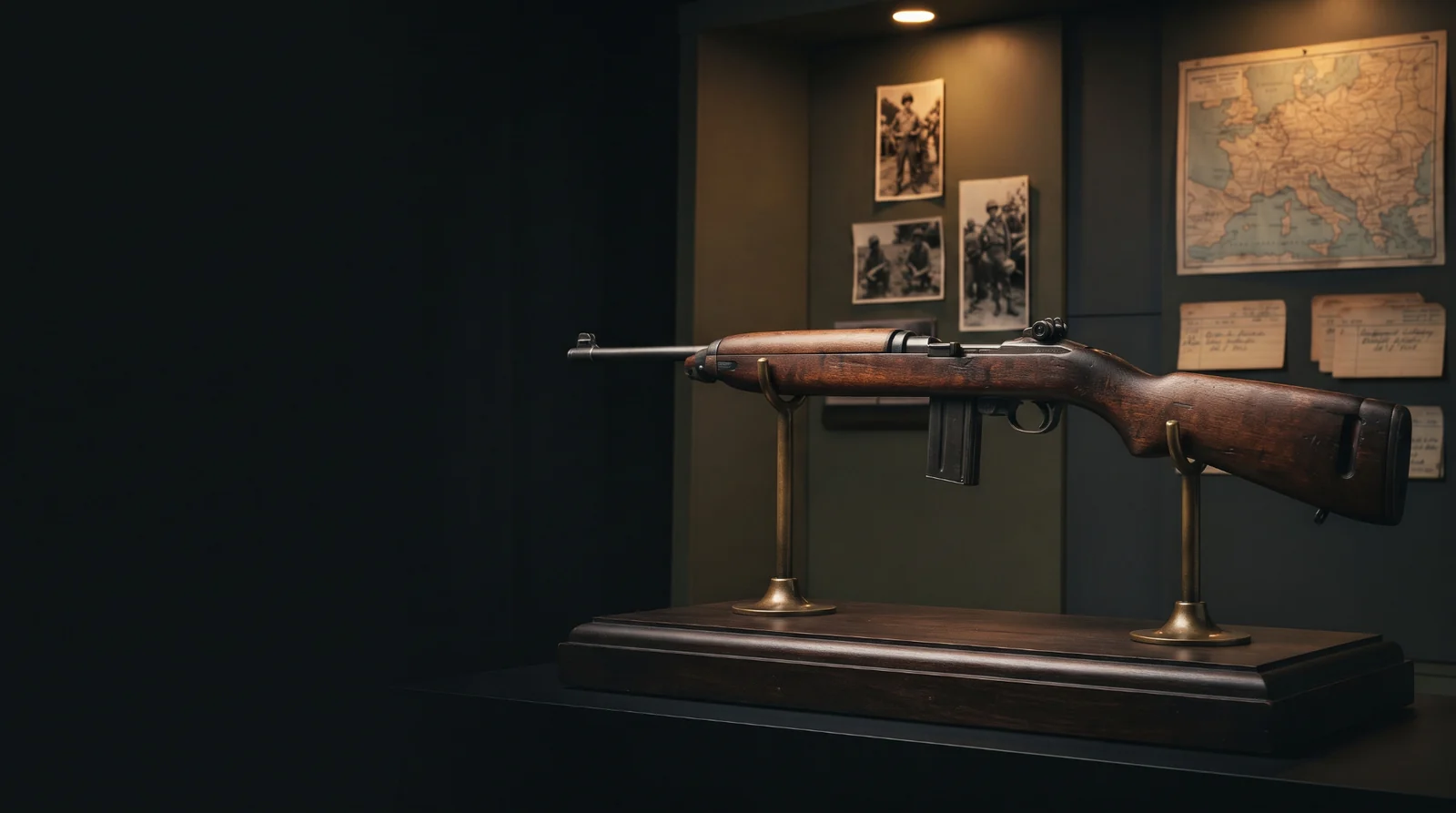
U.S. M1 Carbine is a rifles history rooted in United States. First associated with 1942, the design belongs to the wider story of u.s. service rifles. Its history is best understood through the people, institutions and events behind its name—not as a present-day product listing.
01 / THE ORIGIN
The United States sought a portable long arm for troops whose duties made the standard infantry rifle less convenient. The M1 carbine emerged from this wartime need; it was neither a shortened M1 Garand nor a substitute for every battlefield role. Its name has caused confusion ever since.
02 / THE HISTORICAL JOURNEY
Large-scale production across multiple manufacturers turned it into a characteristic object of wartime American industry. Later appearances during the Korean War and beyond help explain its sustained visibility in photographs, veterans’ stories, and collections.
03 / NAMES, VARIANTS & IDENTITY
The M1 carbine and M1 Garand share a U.S. designation, not a common rifle design. Treat their model histories as separate records.
Names also encountered in historical catalogs and searches include M1 carbine; .30 carbine; WWII carbine. These terms are useful starting points, not proof that two photographed objects share the same maker, date, or military provenance. When reading about a particular surviving specimen, look for a documented institutional collection number, manufacturer record, or contemporary source.
04 / WHY THIS MODEL MATTERS
The carbine is a case study in matching institutional need to an industrial production system. Its legacy is not a contest with the Garand but the history of a different role and a very different manufacturing program.
The broader context is the history of u.s. service rifles. Political institutions, supply contracts, and public memory often determine which firearms remain famous and which survive mainly through specialist archives. These distinctions matter more than modern rankings or unsupported claims of superiority.
Read the expanded historical research file →
THE HISTORICAL RESEARCH FILE
The U.S. M1 Carbine is a separate light-weapon procurement history from the M1 Garand, documented in wartime official photographs and museum records.
01 / A confusing name, a distinct requirement
The M1 Carbine and M1 Garand share an 'M1' designation, but they were different U.S. military arms with distinct intended roles and procurement histories. The Smithsonian's National Museum of American History lists named M1 Carbine objects in its collections, including examples associated with early 1940s production. That independently shows a specific museum trail, while further archival work is needed to attribute every company and contract. An encyclopedia should have a prominent names-disambiguation panel so that users never mistakenly treat the carbine as a shortened Garand. [1]
The carbine belongs in the mobilization history of the Second World War. Its identity reflects a military equipment requirement separate from the service rifle, and its production story involves a far wider U.S. industrial network than a single heroic inventor's name.
02 / Official photographs establish wartime presence
Naval History and Heritage Command collections include photographs from Saipan and Iwo Jima in which the M1 Carbine is specifically identified. Those records are exceptionally useful because their captions offer institutional provenance and concrete date or location context. They do not necessarily prove the weapon's exact manufacturing origin; that requires examining the physical specimen and production records. The difference is a valuable lesson for historical research: a trustworthy photograph caption can establish the type in use at a particular event without documenting a factory serial history. [2]
The carbine also appears in official accounts after the Second World War, reflecting a long institutional life that should be mapped separately from early adoption and wartime distribution.
03 / Industrial history over generic specifications
The most interesting next step is to build a manufacturer's index from period U.S. ordnance reports and government contracts. Names associated with the M1 Carbine crossed sectors of American manufacturing, showing how mass mobilization connected civilian firms to military supply. That industrial history is more distinctive than another short technical box. A reader looking for the origin of an individual specimen may care about maker marks; a general history should describe why many makers participated without giving unsafe operational guidance. [3]
Cross-links should include the M1 Garand, Johnson M1941 and other American wartime procurement stories, each with clear labels that the models were not interchangeable. A museum-gallery caption should specify whether the image is a period photograph, authenticated museum object or contemporary illustration.
QUICK REFERENCE QUESTIONS
Is an M1 Carbine the same firearm as an M1 Garand?
No. The designation overlaps, but the carbine and the Garand have separate design, procurement and service histories.
Are there documented WWII photographs of M1 Carbines?
Yes. U.S. Navy historical collections describe and date several wartime photographs showing M1 Carbines.
THE NEXT ARCHIVAL QUESTION
Compile government contract and maker-by-maker wartime histories using official ordnance and museum records.
Editorial status: sourced historical research draft, not a completed archival verification of all marks, factory totals or service claims. Generated museum artwork is illustrative and not evidence of an authenticated surviving specimen.
THE HISTORICAL TIMELINE
Earliest major introduction or designation associated with this record
The defining historical setting for the model's service and reputation
Variants, national service histories, and museum documentation add important context
Preserved as part of military, sporting or industrial-design history
COMMON HISTORY QUESTIONS
What country did the U.S. M1 Carbine originate in?
The design's principal origin is United States. This is an origin label, not a claim that every later example was manufactured in the same country.
When was the U.S. M1 Carbine introduced?
1942 is the principal milestone used for this record. Prototype dates, military adoption, production, and later models may differ; always check which event a secondary source is dating.
What other names are associated with it?
Common search terms include M1 carbine; .30 carbine; WWII carbine. They may encompass nicknames, related service designations, or model-family references; consult primary documentation before equating specific variants.
EXPLORE CONNECTED HISTORIES
These neighboring biographies help place the model in a broader national or industrial context, without implying they are mechanically identical:
- SKS-45 — Soviet Union
- U.S. M1 Carbine — United States
- Sa vz. 58 — Czechoslovakia
- M1 Garand — United States
SOURCES & FURTHER READING
These links are editorial starting points. Where a linked source concerns a wider model family, a particular example or variant requires its own verification. This page is a historical overview, not an instruction manual.
2 external reading sources currently listed. This biography is a historical research overview; these links are research starting points and may cover a wider model family. They are not a claim that every detail has been independently verified. Our editorial method.
- Historical source: www.americanrifleman.org ↗READING
- Additional institutional or historical reference ↗READING
- Smithsonian — M1 Carbine collections search ↗DOCUMENTED SOURCEEvidence scope: Institutional catalogue identifying surviving M1 Carbine objects.
- Naval History and Heritage Command — Saipan photograph ↗DOCUMENTED SOURCEEvidence scope: Dated official image with M1 Carbine identified in caption.
- Naval History and Heritage Command — Iwo Jima photograph ↗DOCUMENTED SOURCEEvidence scope: Additional official wartime image record.
EDITORIAL EXPANSION: NOVEMBER 2026 · HISTORICAL STUDY · NO SALES, TRANSFERS OR MODIFICATION GUIDANCE.