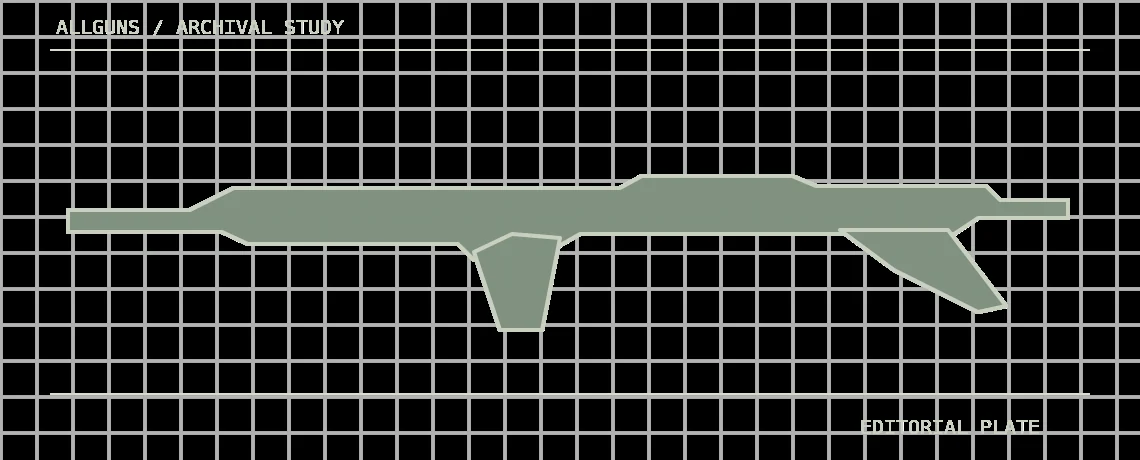
Few industrial designs have traveled as far—or carried as much symbolic weight—as the Kalashnikov rifle family. The AK-47 is a chapter in Soviet manufacturing, decolonization, conflict, and visual culture.
01 / THE ORIGIN
The designation points to 1947, the year associated with Mikhail Kalashnikov’s design, but the rifle was accepted into Soviet service in 1949. It emerged from a long wartime and postwar effort to rethink infantry small arms around new ammunition and the realities of mass production. The famous image of a lone inventor tells only part of the story: testing organizations, factories, and other engineers shaped the eventual production weapon.
02 / THE JOURNEY
The platform spread through Soviet alliances, domestic licensing, and a vast international manufacturing ecosystem. As newer AK-family models replaced early patterns, the name “AK-47” became a loose popular shorthand for many visually similar rifles. Historians are more precise: the earliest AK, the milled-receiver AK variants, the later AKM, and subsequent families are different chapters of a long industrial lineage.
03 / THE LEGACY
The AK’s silhouette crossed from equipment inventories to flags, films, posters, and political symbolism. That extraordinary visibility can obscure the people affected by the wars in which it appeared. Its biography is therefore as much about global history and state production as about the object itself. The enduring story is not a single model frozen in 1947, but an evolving family whose influence extends across continents.
THE HISTORICAL TIMELINE
Design associated with the AK designation
Accepted for Soviet military service
Production and licensed variants spread widely
The broader AK family remains a global reference
SOURCES & READING
These are starting points for independent research. Where sources cover a broader family, model-specific details should be checked against period records.
LAST EDITORIAL REVIEW: NOVEMBER 2026 · HISTORICAL SUMMARY · NO BUY/SELL CONTENT.