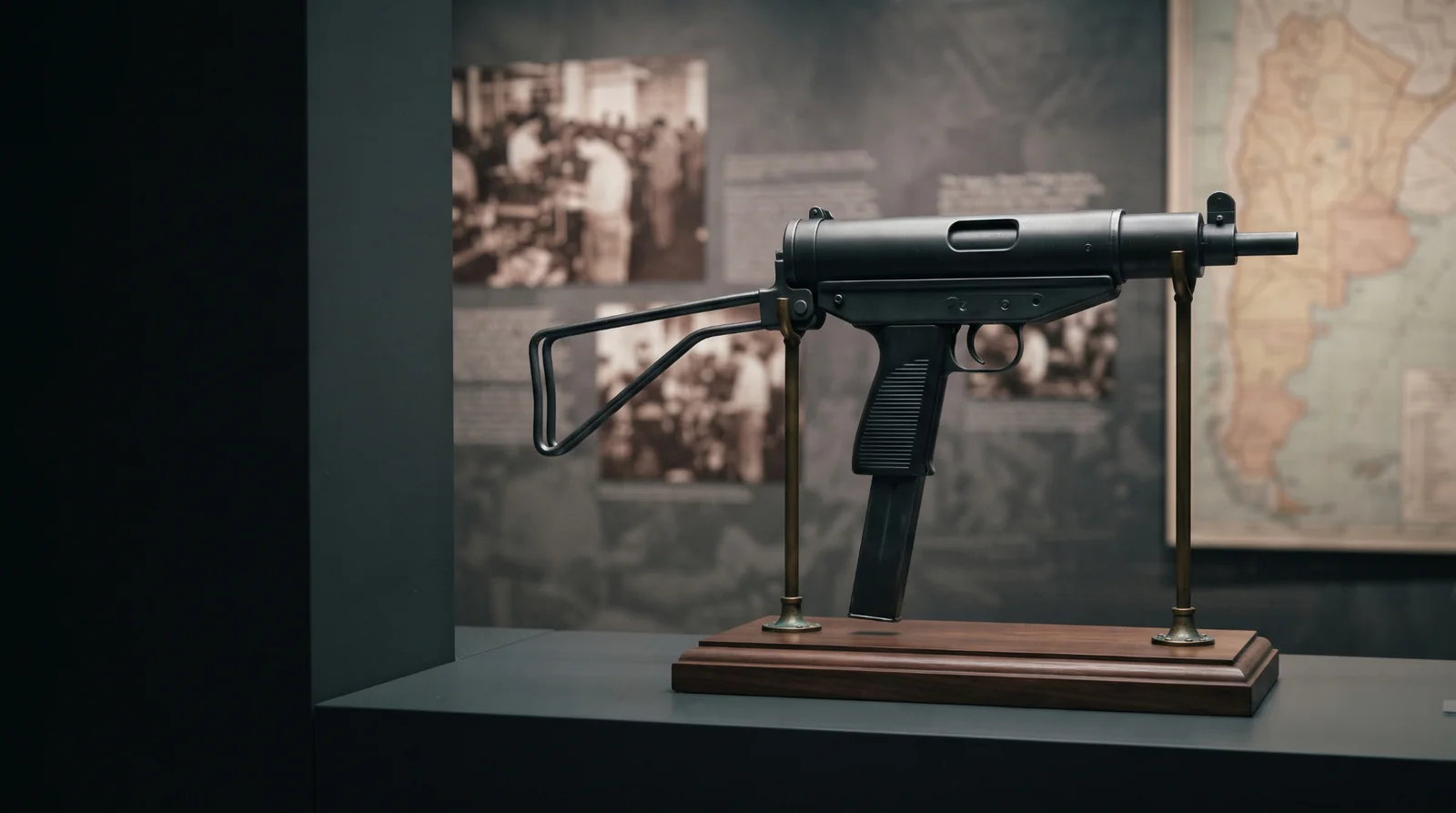
An Argentine-made submachine gun with its own industrial identity. This independent historical overview traces the origin, institutional journey, naming conventions and legacy of FMK-3 rather than promoting contemporary sales or providing operating instructions.
01 / ORIGIN: PEOPLE & FACTORIES
Argentina’s FMK-3 was developed under the national Fabricaciones Militares system during the 1970s. It followed earlier Argentine efforts to manufacture foreign-derived submachine guns, but represents a distinct later domestic project.
02 / SERVICE, ADOPTION & THE HISTORICAL JOURNEY
Police and military inventories give the FMK-3 a service story inside Argentina. Museum research should distinguish the model from the country’s earlier PAM-series weapons, themselves tied to a different manufacturing lineage.
03 / NAMES, MARKS & FAMILY IDENTITY
FMK-3 is the main designation, while PA-3 appears in some historical accounts; this is not simply an Argentine name for the American M3.
Names encountered in catalogs, collections and searches include FMK3; PA-3; Argentine FMK-3 submachine gun. They are useful research leads, but a shared term does not verify a particular artifact's maker or production date. A responsible object record should cite a museum accession, factory mark or authoritative contemporary reference where possible.
04 / WHY IT MATTERS
The FMK-3 lets the archive compare Argentine and Colombian defense manufacturing without asserting a direct design relationship.
THE INDUSTRIAL CONTEXT
Submachine-gun histories are often driven by constraints: wartime urgency, smaller industrial plants, domestic security requirements, and export opportunities. A military model’s significance cannot be measured solely by its appearances in films or its position in a modern ranking.
Read the new source-led dossier →
THE RESEARCH DOSSIER
Argentina’s FMK-3 is a local industry and law-enforcement history, not merely a minor submachine-gun name in an international list.
01 / Domestic manufacture and institutional identity
The FMK-3 belongs to Argentina’s twentieth-century military-industrial infrastructure, especially the state manufacturing organization Fabricaciones Militares and the Domingo Matheu small-arms facility. Spanish-language sources are essential here because translating the model name into generic English can erase its domestic context. Specialist histories place development in the 1970s, but the exact relationship between design, serial manufacture and separate service-adoption dates should be sourced rather than guessed. The Argentine police-history publication is particularly useful for understanding that the model was not solely an abstract army project: law-enforcement procurement and institutional inventories also formed part of its story. That is a richer historical angle than a bare specification table.
02 / Distinguishing the name and the family
References sometimes call the model PA-3 and sometimes FMK-3. The words may reflect developmental or institutional terminology, but a responsible record should not declare every labeled specimen interchangeable. The university-linked history of the Policía Federal gives evidence of a documented acquisition and model naming, while Argentine enthusiast research provides a different perspective on the design’s local identity. Neither source alone is a complete factory serial-number history. Catalog captions and generated images should therefore identify the intended model rather than a particular manufacture year or police unit without evidence. Readers can compare the FMK-3 to the FARA 83 as different Argentine attempts at national small-arms production.
03 / An Argentine research agenda
The strongest next step is to locate FM factory catalogs, procurement dates and Argentine museum accession records. Those would let the page distinguish a design announcement from production, and model nomenclature from later civilian or institutional labels. The current account should retain careful language when discussing distribution outside Argentina or precise quantities built. Its importance is that the firearm provides a window into domestic capabilities and procurement decisions often absent from English-language firearms history. Documenting those decisions rather than offering tactical comparisons is how AllGuns can make a useful original contribution. The image here is explicitly an illustration, not a verified picture of a specific police inventory example.
Still to verify. Locate authenticated Domingo Matheu catalog pages and Argentine museum accessions for PA-3/FMK-3 naming and precise years. Historical museum images on this page are AI illustrations, not authenticated photographs of a particular object.
KEY CHRONOLOGY
Principal milestone for the FMK-3: design, model date, adoption or early production (as explained in the text).
Core historical context for its design and institutional reputation.
Surviving photographs, national variants and museum accession records may document additional chapters.
Its history is studied through collections, manufacturer records and contemporary historical research.
LATIN AMERICAN CONNECTIONS
For a different national program, read the Colombian INDUMIL Jaguar biography. Its industrial setting offers a useful comparison with FMK-3 even though the models are not identical and no direct technical relationship is implied. The Jaguar Civil concept page remains a labeled hypothetical, not a commercial announcement.
THREE RESEARCH QUESTIONS
Where did FMK-3 originate?
Its principal origin is Argentina, associated in this record with Fabricaciones Militares / Domingo Matheu. Design origin, contract manufacture and later service-country inventories are not always the same thing.
What is the main historical milestone?
The chronology centers on 1974 and the Late 20th century setting. Sources sometimes use different dates for prototypes, adoption and production, and those events should not be presented as interchangeable.
Why does this design deserve its own biography?
The FMK-3 lets the archive compare Argentine and Colombian defense manufacturing without asserting a direct design relationship.
CONNECTED BIOGRAPHIES
Explore these related histories for context, without assuming the firearms share identical designs or service records:
- Owen Gun — a related historical record
- Sterling L2A3 — a related historical record
- Carl Gustaf m/45 — a related historical record
- Beretta M12 — a related historical record
SOURCES & RESEARCH NOTES
Research starting point: the reference below documents this model, its program, or the wider historical context. Where it covers an entire family, dates and claims about a particular variant should be checked against an object-level record. Do not mistake generated editorial artwork or textual summaries for archival primary evidence.
1 external reading source currently listed. This biography is a historical research overview; these links are research starting points and may cover a wider model family. They are not a claim that every detail has been independently verified. Our editorial method.
- universidad-policial.edu.ar — historical reference ↗EXTERNAL
- AllGuns.co research method and source policy ↗METHOD
- CESBA Rosario — FMK-3 historical article ↗RESEARCHArgentine-language secondary treatment of model and factory.
- Modern Firearms — FMK-3 ↗RESEARCHIndependent specialist chronology, to verify against local sources.
REVIEWED 2026-11-21 · INDEPENDENT HISTORY · NO GUN SALES OR MODIFICATION INSTRUCTIONS.