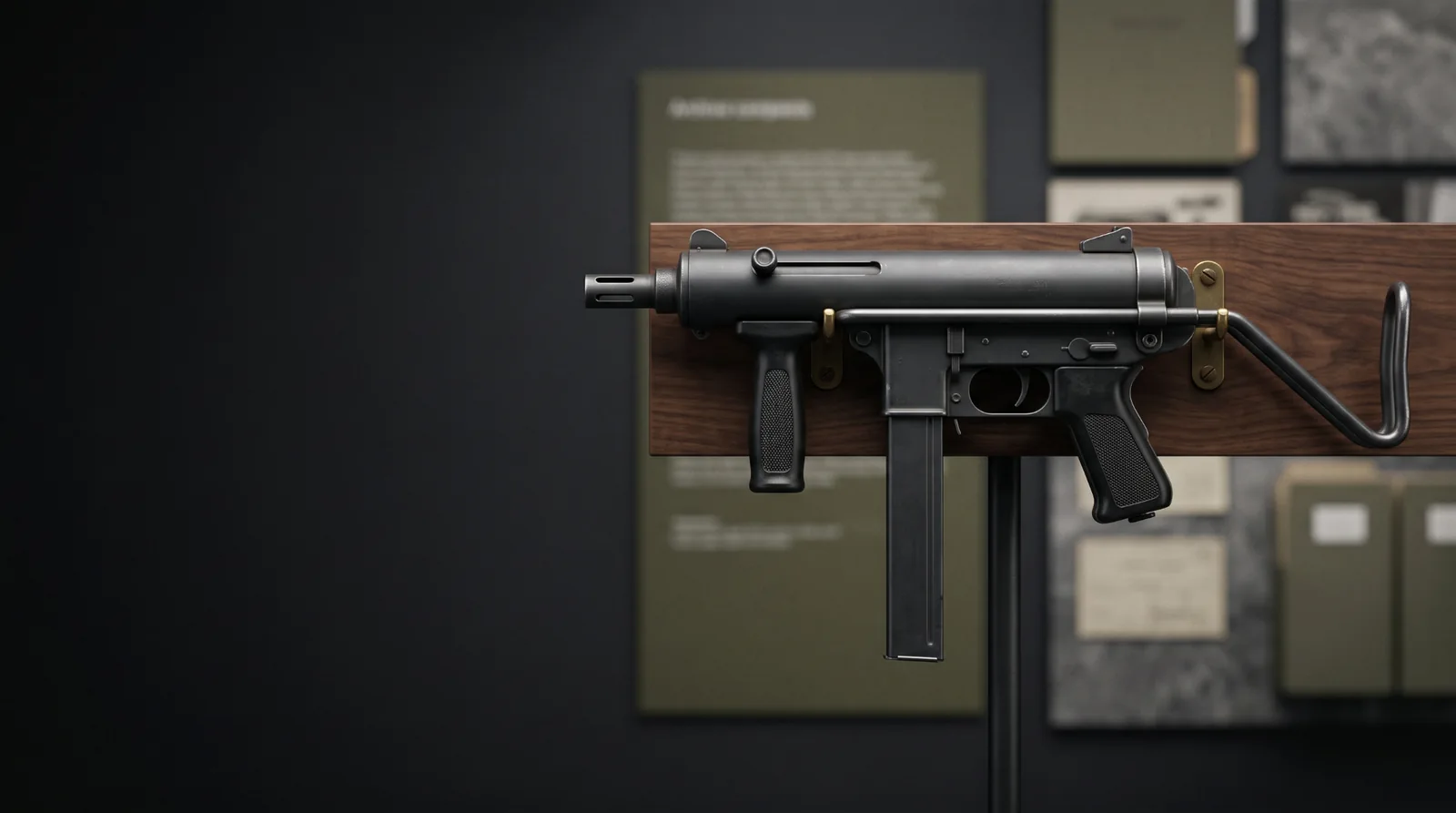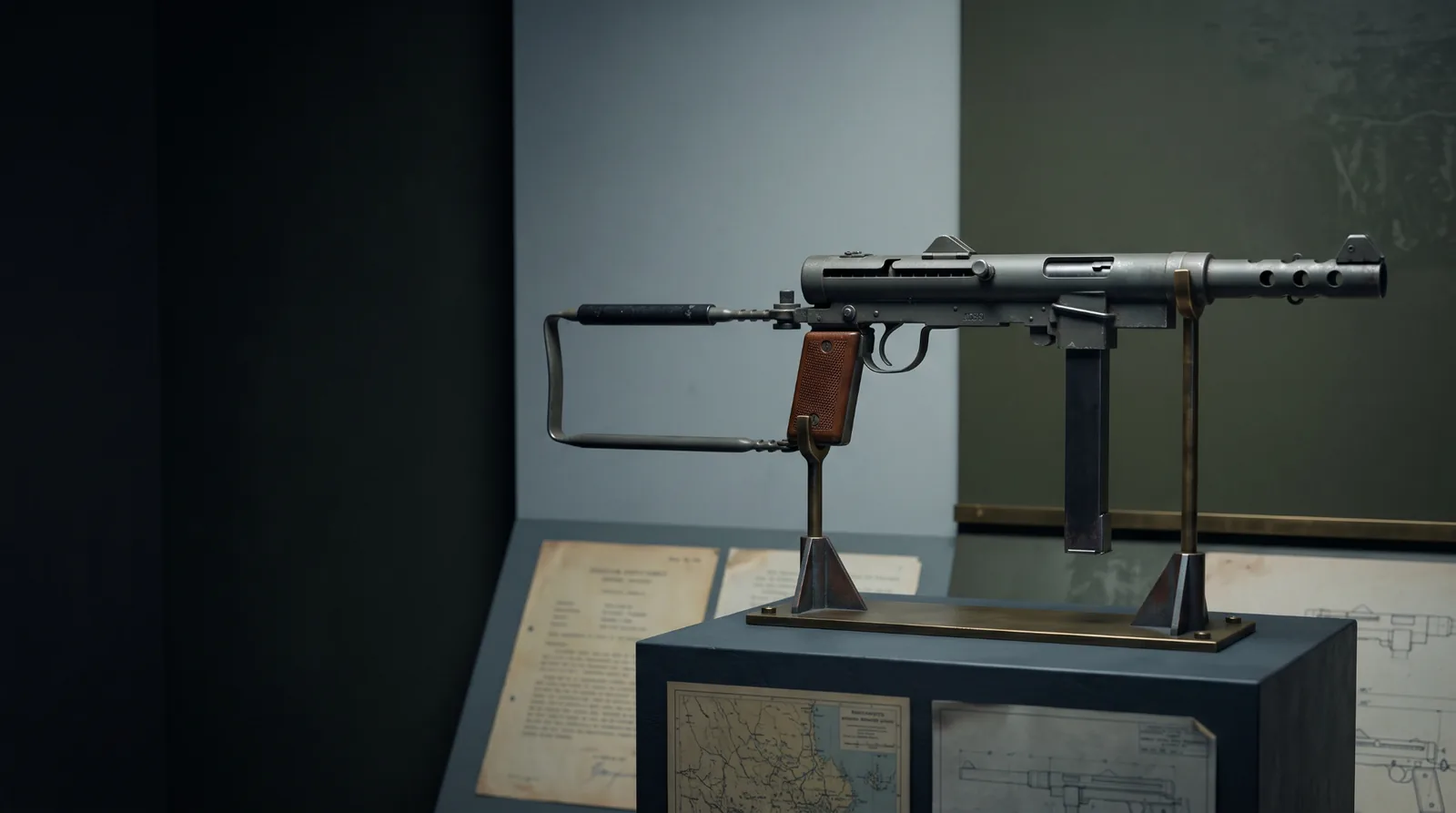
Carl Gustaf m/45 is a submachine guns history rooted in Sweden. First associated with 1945, the design belongs to the wider story of cold war submachine guns. Its history is best understood through the people, institutions and events behind its name—not as a present-day product listing.
01 / THE ORIGIN
Sweden’s postwar submachine gun program produced the m/45 in 1945. The Carl Gustaf association and the later American nickname “Swedish K” reflect a national designation acquiring an international afterlife.
02 / THE HISTORICAL JOURNEY
Swedish service formed the core story, while later foreign use and popular histories created separate layers of interest. Published references to m/45, m/45B, and the Port Said family deserve careful separation.
03 / NAMES, VARIANTS & IDENTITY
“Swedish K” is a nickname; “m/45” and “m/45B” are historically specific designations.
Names also encountered in historical catalogs and searches include Swedish K; m/45; Kpist m/45. These terms are useful starting points, not proof that two photographed objects share the same maker, date, or military provenance. When reading about a particular surviving specimen, look for a documented institutional collection number, manufacturer record, or contemporary source.
04 / WHY THIS MODEL MATTERS
This rifle-sized cultural fame from a relatively compact object is part of the history of Cold War small states and manufacturing. Its names travel much farther than its original institutional setting.
The broader context is the history of cold war submachine guns. Political institutions, supply contracts, and public memory often determine which firearms remain famous and which survive mainly through specialist archives. These distinctions matter more than modern rankings or unsupported claims of superiority.
THE RESEARCH DOSSIER
Swedish postwar procurement and the m/45 submachine gun. This supplemental research section separates sourced historical context from model-family interpretation and questions requiring object-level proof.
01 / Postwar Swedish identity
The Carl Gustaf m/45, often called the Swedish K in English-language writing, is a Swedish submachine-gun design closely associated with the immediate post-World War II period. The name “m/45” should be treated as a service designation, while “Swedish K” is a commonly used nickname and search term. Sweden's industrial setting and procurement requirements are essential to the biography; the model cannot be understood solely through later international photographs. The Smithsonian collection database includes entries for Carl Gustav m/45-family objects, anchoring the design in material collections rather than in internet folklore alone.
02 / A design with a longer public reputation
As the m/45 acquired attention outside Sweden, later retellings sometimes compressed official Swedish service, foreign institutional use and screen recognition into one continuous story. A credible reference article keeps those contexts separate and requires sources for specific deployments or agency procurements. Some descriptions are based on a particular photograph of a person carrying a submachine gun; unless the photograph's origin and caption are verified, that is weak proof of a unit's armament. A dated arsenal or museum entry is more useful than a list of famous appearances without provenance.
03 / Naming and surviving examples
Museum search results may call the firearm “Carl Gustav,” “Carl Gustaf,” “Kulsprutepistol m/45” or “Swedish K.” These search aliases do not mean that every item shares exactly the same configuration or production context. A specimen entry should identify the original manufacturer, recorded country of origin, service designation and any verified subsequent custody. Such fields are what make an encyclopedia usable for readers comparing national service designs. The Smithsonian index confirms relevant collection objects, while technical subvariant claims require better period documentation before publication.
04 / What remains for verification
An additional archival pass should seek Swedish-language military documents and a named national museum accession rather than rely exclusively on broad English-language secondary summaries. That is particularly important where an article discusses foreign users or production variants. The present research notes establish a conservative service-family history and documented existence of museum examples without attaching unsupported numerical production claims or sensational anecdotes. Historical restraint is a feature of a trustworthy reference library, not a lack of editorial ambition.
Evidence note. Manufacturer sources establish corporate chronology, while museum catalog entries document particular objects. Historical journalism provides context. The linked records do not verify the provenance or exact construction of our AI illustrations.
THE HISTORICAL TIMELINE
Earliest major introduction or designation associated with this record
The defining historical setting for the model's service and reputation
Variants, national service histories, and museum documentation add important context
Preserved as part of military, sporting or industrial-design history
COMMON HISTORY QUESTIONS
What country did the Carl Gustaf m/45 originate in?
The design's principal origin is Sweden. This is an origin label, not a claim that every later example was manufactured in the same country.
When was the Carl Gustaf m/45 introduced?
1945 is the principal milestone used for this record. Prototype dates, military adoption, production, and later models may differ; always check which event a secondary source is dating.
What other names are associated with it?
Common search terms include Swedish K; m/45; Kpist m/45. They may encompass nicknames, related service designations, or model-family references; consult primary documentation before equating specific variants.
EXPLORE CONNECTED HISTORIES
These neighboring biographies help place the model in a broader national or industrial context, without implying they are mechanically identical:
- Beretta M12 — Italy
SOURCES & FURTHER READING
These links are editorial starting points. Where a linked source concerns a wider model family, a particular example or variant requires its own verification. This page is a historical overview, not an instruction manual.
2 model-focused research references documented in the November 2026 editorial pass. Sources are cited for the claims and time periods described, not as proof of every surviving variant. Review the editorial standards.
- Smithsonian collections — submachine guns ↗RESEARCHAlternative museum catalog search
- Smithsonian collections — Carl Gustav m/45 records ↗RESEARCHMuseum collection index documenting surviving m/45 family objects
- Historical source: www.dia.mil ↗READING
REFERENCE DOSSIER EXPANDED: NOVEMBER 21, 2026 · HISTORICAL RESEARCH · NO SALES OR OPERATING GUIDANCE.