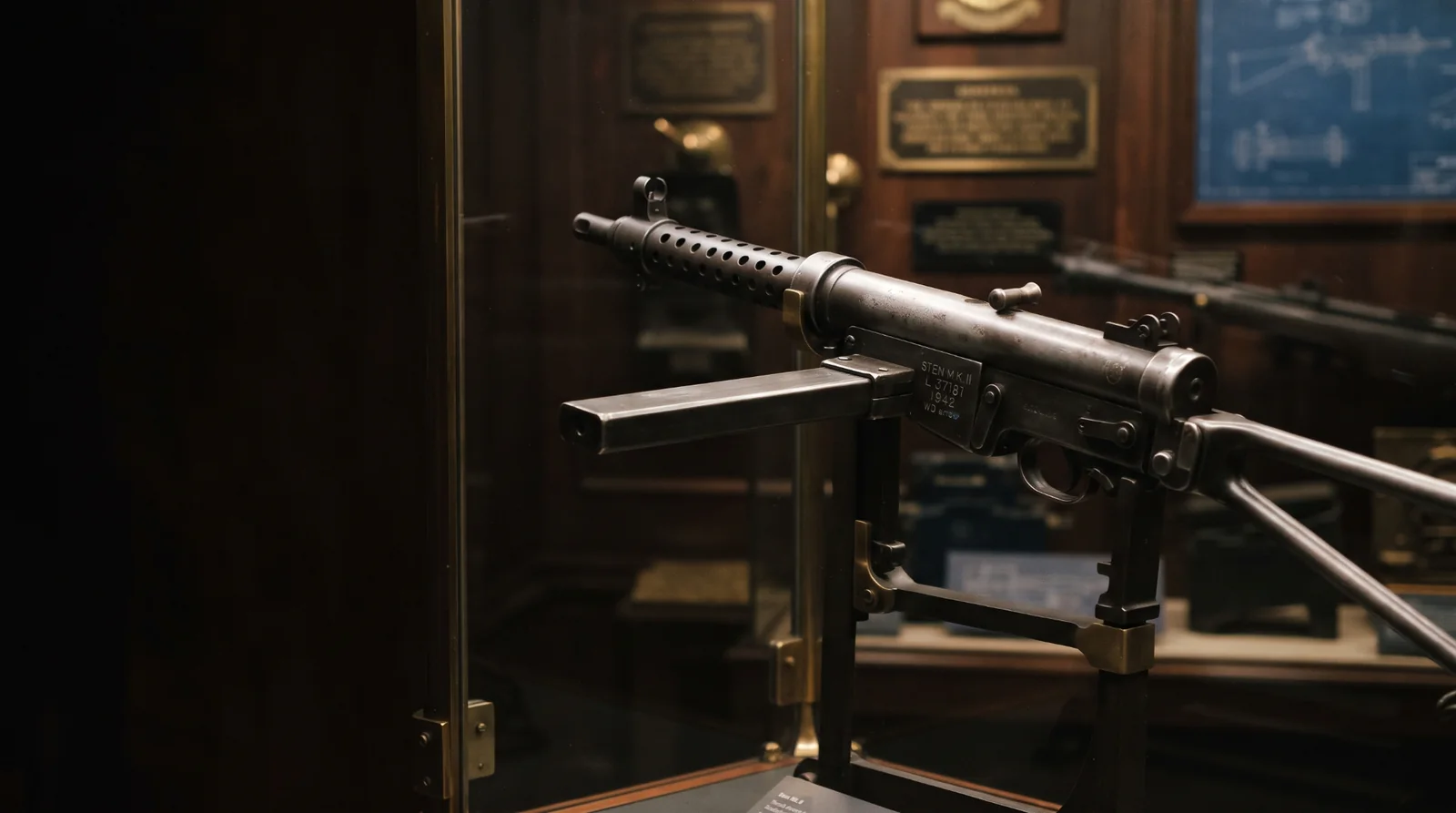
The British emergency-production submachine gun. This independent historical overview traces the origin, institutional journey, naming conventions and legacy of Sten Mk II rather than promoting contemporary sales or providing operating instructions.
01 / ORIGIN: PEOPLE & FACTORIES
The Sten emerged during a British wartime manufacturing emergency. The name itself is closely associated with Shepherd, Turpin and Enfield, and the design’s industrial simplicity reflected the urgent need for rapid production.
02 / SERVICE, ADOPTION & THE HISTORICAL JOURNEY
The Mk II became one of the most recognizable Sten patterns of the Second World War, serving British and allied forces. Individual wartime examples vary in markings and production details, making specimen-level identification a separate task from telling the overall story.
03 / NAMES, MARKS & FAMILY IDENTITY
Sten Mk II is a specific model within a series that also includes different earlier and later marks. Not every Sten photograph depicts a Mk II.
Names encountered in catalogs, collections and searches include STEN gun Mk2; Sten Mark II; Sten machine carbine. They are useful research leads, but a shared term does not verify a particular artifact's maker or production date. A responsible object record should cite a museum accession, factory mark or authoritative contemporary reference where possible.
04 / WHY IT MATTERS
Its historical significance is its factory and logistics context: the ability to produce large numbers under pressure, rather than any claim of mechanical elegance.
THE INDUSTRIAL CONTEXT
Submachine-gun histories are often driven by constraints: wartime urgency, smaller industrial plants, domestic security requirements, and export opportunities. A military model’s significance cannot be measured solely by its appearances in films or its position in a modern ranking.
Read the new source-led dossier →
THE RESEARCH DOSSIER
The Sten Mk II is a manufacturing history first: an emergency British wartime system whose cultural fame can obscure the separate records of its marks.
01 / A solution to a production crisis
In 1940–41 Britain was under pressure to supply large numbers of relatively simple automatic small arms. The Sten is therefore inseparable from wartime production organization. The Royal Armouries documents how companies far outside traditional arms manufacturing—including a well-known toy manufacturer—contributed to the program. That breadth of participation matters more than a modern claim that simplicity is inherently good or bad. The Mk II emerged within a family that changed through the war, so its identity must be tied to a specific configuration rather than any image labeled “Sten.” The National Army Museum catalogues an Mk II associated with 1941, giving the account an identifiable institutional object rather than just a popular nickname.
02 / The problem with treating every Sten as one gun
The Sten family includes multiple numbered marks and specialized versions, reflecting different periods and production constraints. Popular photographs often flatten them into one silhouette. The Royal Armouries article distinguishes Mk II features from those of a later sheet-metal variant; that comparison is a valuable corrective for a model-specific biography. Names in period catalogs can also use the formal term machine carbine. This entry therefore treats “Sten” as a family designation and “Mk II” as a more exact one. A photographed weapon’s accessories and exterior details cannot establish its maker or wartime service without marks and provenance. That caution matters especially when thousands of examples moved through military storage and later surplus channels.
03 / Why the industrial story survives
The Sten’s historical significance lies partly in the scale of its manufacturing ecosystem and its British and Commonwealth wartime use. The National Army Museum’s collection is a better starting point for these claims than internet lists of purported performance records. Its object entry confirms a wartime Mk II specimen and historical setting; the Armouries material gives a window into suppliers. Together they establish different kinds of evidence. Further research should connect procurement contracts to factories and production years, and should clearly separate wartime British use from later international circulation. Our illustration is not a photograph of the museum accession, so it must never be used to infer a factory code or authenticity of markings.
Still to verify. Check factory contracts, mark-by-mark official nomenclature and surviving production labels before adding maker-level identifications. Historical museum images on this page are AI illustrations, not authenticated photographs of a particular object.
KEY CHRONOLOGY
Principal milestone for the Sten Mk II: design, model date, adoption or early production (as explained in the text).
Core historical context for its design and institutional reputation.
Surviving photographs, national variants and museum accession records may document additional chapters.
Its history is studied through collections, manufacturer records and contemporary historical research.
THREE RESEARCH QUESTIONS
Where did Sten Mk II originate?
Its principal origin is United Kingdom, associated in this record with British state and contract manufacturers. Design origin, contract manufacture and later service-country inventories are not always the same thing.
What is the main historical milestone?
The chronology centers on 1941 and the World War II setting. Sources sometimes use different dates for prototypes, adoption and production, and those events should not be presented as interchangeable.
Why does this design deserve its own biography?
Its historical significance is its factory and logistics context: the ability to produce large numbers under pressure, rather than any claim of mechanical elegance.
CONNECTED BIOGRAPHIES
Explore these related histories for context, without assuming the firearms share identical designs or service records:
- Owen Gun — a related historical record
- Sterling L2A3 — a related historical record
- Carl Gustaf m/45 — a related historical record
- Beretta M12 — a related historical record
SOURCES & RESEARCH NOTES
Research starting point: the reference below documents this model, its program, or the wider historical context. Where it covers an entire family, dates and claims about a particular variant should be checked against an object-level record. Do not mistake generated editorial artwork or textual summaries for archival primary evidence.
1 external reading source currently listed. This biography is a historical research overview; these links are research starting points and may cover a wider model family. They are not a claim that every detail has been independently verified. Our editorial method.
- collection.nam.ac.uk — historical reference ↗EXTERNAL
- AllGuns.co research method and source policy ↗METHOD
- Royal Armouries — From toys to Stens ↗RESEARCHResearch on wartime distributed production and mark distinctions.
REVIEWED 2026-11-21 · INDEPENDENT HISTORY · NO GUN SALES OR MODIFICATION INSTRUCTIONS.