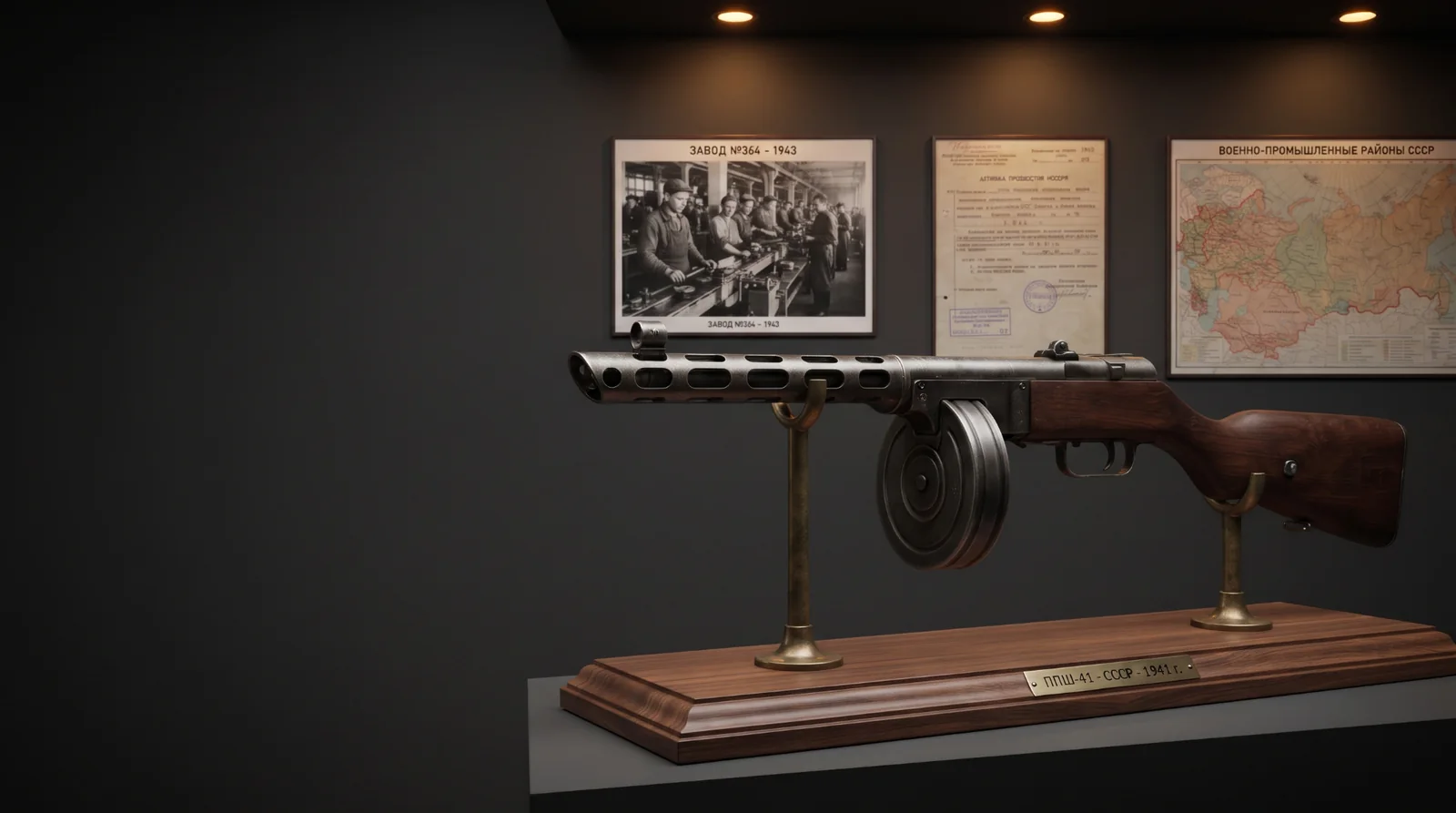
A Soviet wartime design shaped by industrial scale. This independent historical overview traces the origin, institutional journey, naming conventions and legacy of PPSh-41 rather than promoting contemporary sales or providing operating instructions.
01 / ORIGIN: PEOPLE & FACTORIES
Georgy Shpagin’s submachine gun emerged amid a Soviet emphasis on rapidly producing infantry arms during the Second World War. Its distinctive appearance and enormous wartime visibility ensured a lasting place in popular history.
02 / SERVICE, ADOPTION & THE HISTORICAL JOURNEY
The PPSh-41 became a familiar Soviet weapon across the Eastern Front and also appeared beyond the Soviet Union in subsequent service histories. Museums distinguish Russian wartime examples from later foreign manufacture and reuse.
03 / NAMES, MARKS & FAMILY IDENTITY
PPSh-41, PPSh 41 and Shpagin SMG are common search labels; later copy designs and related Soviet models such as the PPS-43 are separate entries.
Names encountered in catalogs, collections and searches include PPSh 41; Shpagin 1941; Pistolet-Pulemyot Shpagina. They are useful research leads, but a shared term does not verify a particular artifact's maker or production date. A responsible object record should cite a museum accession, factory mark or authoritative contemporary reference where possible.
04 / WHY IT MATTERS
This firearm is a strong way to discuss wartime industry, propaganda photography and the difficulties of interpreting a model exclusively through its most iconic images.
THE INDUSTRIAL CONTEXT
Submachine-gun histories are often driven by constraints: wartime urgency, smaller industrial plants, domestic security requirements, and export opportunities. A military model’s significance cannot be measured solely by its appearances in films or its position in a modern ranking.
Read the new source-led dossier →
THE RESEARCH DOSSIER
The PPSh-41 was an icon of Soviet wartime mass mobilization, but its history rests as much in factory organization as in battlefield imagery.
01 / A wartime manufacture problem
The PPSh-41 emerged from the Soviet need for mass-produced personal arms amid the mobilization of 1941. Georgy Shpagin’s design is strongly associated with production economy and the pressures of total war. That context helps explain why the PPSh became so prominent in Soviet imagery: it was a weapon of industrial output as much as a symbol of front-line service. A serious history should connect it to reorganization of factories and state procurement, while resisting unsourced claims that every simplified manufacturing choice followed one single battlefield lesson.
02 / Surviving objects versus iconic photographs
The Smithsonian’s National Museum of American History catalogues more than one Soviet PPSh-41, including specimens dated to the early 1940s. These accession records are useful anchors: they establish that objects of this model survive in institutional collections, with recorded date associations and measurements. A museum record is narrower evidence than a broad narrative about how the model was distributed, but that narrowness is a virtue. It reminds writers that an individual object, its known maker and its documented history must not be conflated with assumptions about millions of similar-looking arms.
03 / Connections with the Finnish and Soviet lineages
The PPSh’s historical background overlaps the Soviet experience of the Winter War and international attention to the Finnish Suomi KP/-31. Those links are worth exploring, but influence is not the same as proof of copying. The PPSh also needs to be distinguished from the later PPS-43: the two share a wartime Soviet setting while reflecting different industrial circumstances. Comparing their institutional histories reveals the changing demands placed on Soviet industry from 1941 to the Siege of Leningrad. It is these relationships—not claims about a model being simply “best”—that make an encyclopedia entry informative.
Still to verify. Check precise production figures and claims of Finnish design influence against Soviet procurement and factory documents. Historical museum images on this page are AI illustrations, not authenticated photographs of a particular object.
KEY CHRONOLOGY
Principal milestone for the PPSh-41: design, model date, adoption or early production (as explained in the text).
Core historical context for its design and institutional reputation.
Surviving photographs, national variants and museum accession records may document additional chapters.
Its history is studied through collections, manufacturer records and contemporary historical research.
THREE RESEARCH QUESTIONS
Where did PPSh-41 originate?
Its principal origin is Soviet Union, associated in this record with Soviet wartime factories. Design origin, contract manufacture and later service-country inventories are not always the same thing.
What is the main historical milestone?
The chronology centers on 1941 and the World War II setting. Sources sometimes use different dates for prototypes, adoption and production, and those events should not be presented as interchangeable.
Why does this design deserve its own biography?
This firearm is a strong way to discuss wartime industry, propaganda photography and the difficulties of interpreting a model exclusively through its most iconic images.
CONNECTED BIOGRAPHIES
Explore these related histories for context, without assuming the firearms share identical designs or service records:
- Owen Gun — a related historical record
- Sterling L2A3 — a related historical record
- Carl Gustaf m/45 — a related historical record
- Beretta M12 — a related historical record
SOURCES & RESEARCH NOTES
Research starting point: the reference below documents this model, its program, or the wider historical context. Where it covers an entire family, dates and claims about a particular variant should be checked against an object-level record. Do not mistake generated editorial artwork or textual summaries for archival primary evidence.
1 external reading source currently listed. This biography is a historical research overview; these links are research starting points and may cover a wider model family. They are not a claim that every detail has been independently verified. Our editorial method.
- forgottenweapons.com — historical reference ↗EXTERNAL
- AllGuns.co research method and source policy ↗METHOD
- Smithsonian: PPSh-41 collection record ↗RESEARCHAccessioned early-war museum artifact.
- Historic Breechloading Smallarms Association: PPSh-41 history ↗RESEARCHSpecialist historical summary, including Winter War context.
REVIEWED 2026-11-21 · INDEPENDENT HISTORY · NO GUN SALES OR MODIFICATION INSTRUCTIONS.