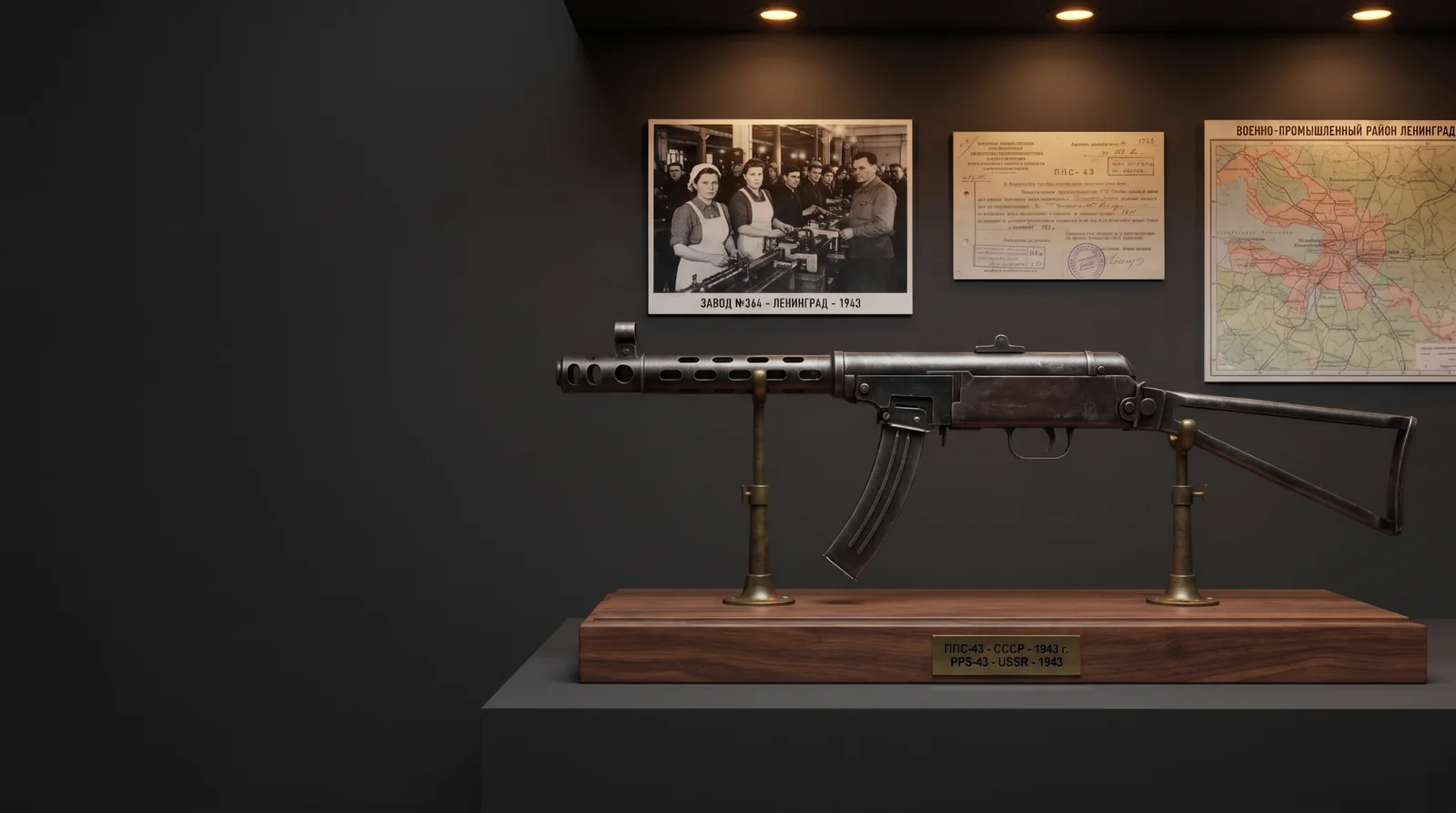
The Soviet alternative developed under siege-era constraints. This independent historical overview traces the origin, institutional journey, naming conventions and legacy of PPS-43 rather than promoting contemporary sales or providing operating instructions.
01 / ORIGIN: PEOPLE & FACTORIES
Alexei Sudayev’s PPS family is associated with a wartime search for submachine guns that were practical to manufacture under severe industrial pressures. The often-cited Leningrad development context is essential to its history.
02 / SERVICE, ADOPTION & THE HISTORICAL JOURNEY
The PPS-43 coexisted with the PPSh-41 rather than simply replacing it everywhere. Factories already making the older model often continued production, while the newer design was suited to other manufacturing arrangements.
03 / NAMES, MARKS & FAMILY IDENTITY
PPS-43 and earlier PPS-42 patterns are related but not identical; wartime dates and local production must be treated carefully.
Names encountered in catalogs, collections and searches include PPS43; Sudayev PPS-43; Pistolet-Pulemyot Sudayeva. They are useful research leads, but a shared term does not verify a particular artifact's maker or production date. A responsible object record should cite a museum accession, factory mark or authoritative contemporary reference where possible.
04 / WHY IT MATTERS
The PPS illustrates how military standardization can be plural: competing designs may remain useful because the factories behind them have different capabilities.
THE INDUSTRIAL CONTEXT
Submachine-gun histories are often driven by constraints: wartime urgency, smaller industrial plants, domestic security requirements, and export opportunities. A military model’s significance cannot be measured solely by its appearances in films or its position in a modern ranking.
Read the new source-led dossier →
THE RESEARCH DOSSIER
Aleksey Sudayev’s PPS-43 is inseparable from besieged Leningrad and a wartime industrial program under severe constraints.
01 / Designed under extraordinary pressure
The PPS program is often summarized as a compact Soviet wartime submachine gun. Its more remarkable historical setting was the Siege of Leningrad. Sudayev developed the predecessor PPS-42 in 1942, and a revised design became the PPS-43. An official Bank of Russia commemorative record describes Sudayev’s career and links the 1943 revision to a system demanding fewer industrial resources than earlier models. That is a better starting point than a generic list of dimensions: the story concerns labor, materials and the state’s attempt to maintain output while normal supply routes were threatened.
02 / A production decision is part of the history
St. Petersburg’s official archival service reports that Soviet authorities arranged manufacture within besieged Leningrad because deliveries into the city were difficult while military demand persisted. That historical setting helps explain why production economy received so much attention. It does not mean every surviving PPS-43 was produced inside the city, or that one version of the production story accounts for every export and later copy. The predecessor PPS-42, the revised PPS-43 and subsequent non-Soviet variants must be handled separately in photographs, captions and model timelines.
03 / Museum evidence versus wartime legend
Claims that the PPS-43 was “cheaper,” “simpler” or the “best” wartime design often appear without defined measurements. The cultural heritage museum and Bank of Russia provide actual comparative resource claims, but those should be quoted with attribution and their historical framing intact rather than converted into universal rankings. For future work, historians should seek factory records, wartime acceptance documents and accessioned examples from different production sites. The generated image here conveys a museum presentation and is not evidence of any particular Leningrad-made object.
Still to verify. Corroborate specific factory output and variant-identification claims with inventories rather than generalized wartime production summaries. Historical museum images on this page are AI illustrations, not authenticated photographs of a particular object.
KEY CHRONOLOGY
Principal milestone for the PPS-43: design, model date, adoption or early production (as explained in the text).
Core historical context for its design and institutional reputation.
Surviving photographs, national variants and museum accession records may document additional chapters.
Its history is studied through collections, manufacturer records and contemporary historical research.
THREE RESEARCH QUESTIONS
Where did PPS-43 originate?
Its principal origin is Soviet Union, associated in this record with Soviet wartime factories. Design origin, contract manufacture and later service-country inventories are not always the same thing.
What is the main historical milestone?
The chronology centers on 1943 and the World War II setting. Sources sometimes use different dates for prototypes, adoption and production, and those events should not be presented as interchangeable.
Why does this design deserve its own biography?
The PPS illustrates how military standardization can be plural: competing designs may remain useful because the factories behind them have different capabilities.
CONNECTED BIOGRAPHIES
Explore these related histories for context, without assuming the firearms share identical designs or service records:
- Owen Gun — a related historical record
- Sterling L2A3 — a related historical record
- Carl Gustaf m/45 — a related historical record
- Beretta M12 — a related historical record
SOURCES & RESEARCH NOTES
Research starting point: the reference below documents this model, its program, or the wider historical context. Where it covers an entire family, dates and claims about a particular variant should be checked against an object-level record. Do not mistake generated editorial artwork or textual summaries for archival primary evidence.
1 external reading source currently listed. This biography is a historical research overview; these links are research starting points and may cover a wider model family. They are not a claim that every detail has been independently verified. Our editorial method.
- forgottenweapons.com — historical reference ↗EXTERNAL
- AllGuns.co research method and source policy ↗METHOD
- Bank of Russia: Sudayev commemorative record ↗RESEARCHInstitutional narrative describing PPS-42 to PPS-43 transition and industrial economy.
- St Petersburg government archives: Leningrad industrial history ↗RESEARCHOfficial archival account of wartime adoption and production context.
REVIEWED 2026-11-21 · INDEPENDENT HISTORY · NO GUN SALES OR MODIFICATION INSTRUCTIONS.